
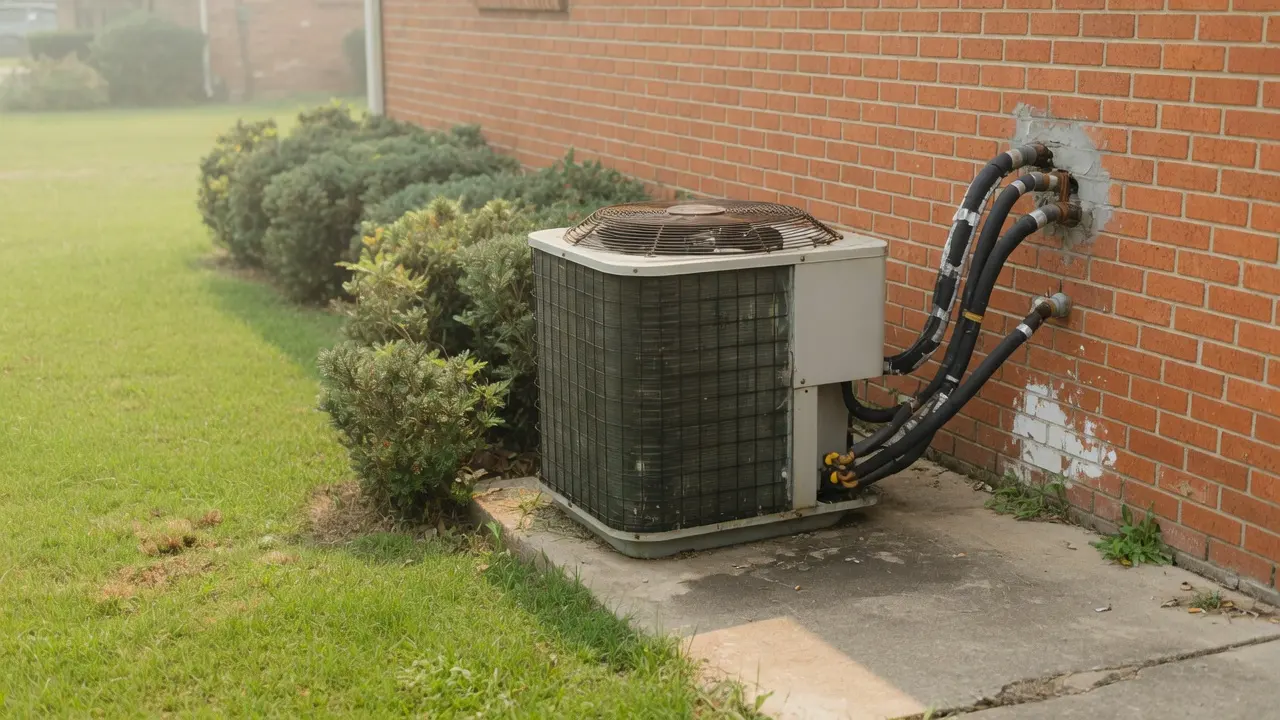
Homeowners can handle basic troubleshooting such as replacing filters, adjusting settings, and cleaning outdoor debris, while more complex repairs require professional HVAC assistance. Identifying the cause early and scheduling proper repairs helps prevent larger system failures, expensive damage, and loss of home comfort.
It happens every summer. It is the hottest week of July, the sun is baking your roof, and you walk through the front door expecting a refreshing blast of cold air. Instead? You get hit with a wall of muggy, lukewarm air. Your system is running, the vents are blowing, but your air conditioner isn't cooling the house at all.
Before you panic about massive replacement costs, take a breath. As technicians, we run hundreds of these service calls, and the reality is often much less scary than you think. Frequently, it is a simple 60-second fix you can do yourself. Let's break down exactly what is causing your AC cooling problem and how to troubleshoot it like a pro.
Quick Answer: Why Your AC Is Running But Not Cooling
Wondering why your air conditioner runs non-stop without actually dropping the temperature? Usually, it boils down to choked-off airflow from a filthy filter, or someone accidentally bumped the thermostat fan setting. If it isn't one of those easy fixes, you're likely looking at low Freon levels, a condenser out back packed with dirt, or an indoor coil encased in a block of solid ice.
10 Common Reasons Your AC Isn't Cooling
1. A Clogged or Dirty Air Filter (DIY Fix)
How restricted airflow freezes the evaporator coil.
Many "no cool" emergency service calls end with a technician simply pulling out a filthy filter. Your AC requires a constant volume of warm air moving across the indoor coil. When thick dust builds up, it stops room air from reaching the cold coil. Without heat to absorb, the coil drops below freezing and turns into a solid block of ice, killing your cooling power. Check your filter now. Staying on top of routine AC maintenance prevents this frustrating bottleneck completely.
2. Incorrect Thermostat Settings (DIY Fix)
Checking the "Auto" vs. "On" switch.
This sounds too simple to be true, but it tricks thousands of homeowners. Look at your wall unit's fan switch. If it got bumped to "On", the indoor blower runs non-stop, 24 hours a day. The outdoor compressor cycles on and off as needed. When the outdoor unit rests, your indoor fan just blows room-temperature air. You feel warm air and assume the system broke. Verifying your thermostat settings takes ten seconds and costs nothing.
3. Refrigerant Leaks (Low Freon) (Pro Fix)
Signs of a leak (hissing noises, ice on lines).
Air conditioners do not consume refrigerant the way a car burns gas. They operate on a sealed loop. If a technician says you are low on Freon, you have a physical leak in the copper lines. Sometimes these leaks are microscopic, other times, they are obvious. If you hear a faint hissing sound or spot thick white ice on the outside copper pipes, you have a leak requiring a professional patch.
4. Dirty Condenser Coils (DIY/Pro Fix)
How outdoor debris traps heat inside.
Your exterior condenser's primary job is to dump indoor heat outside. During spring, the metal fins get plastered with wet leaves, grass clippings, and cottonwood fluff. When the unit wears a thick sweater of yard debris, the heat remains trapped inside. The compressor gets hotter until it can no longer cool your home efficiently. Grab a garden hose and gently rinse the debris off the outside.
5. A Frozen Evaporator Coil (Pro Fix)
Why turning off the AC immediately is critical.
If you see a glacier of ice covering your indoor unit or water pooling rapidly as it melts, you have a frozen coil. Turn the system off immediately. Homeowners hate doing this in the heat, but running a frozen AC permanently destroys your compressor. The ice acts as an insulator, and liquid refrigerant flows backward into the outdoor unit, shattering the internal valves.
6. Blocked or Leaky Ductwork (Pro Fix)
Losing cold air in the attic or walls.
If your equipment runs flawlessly but your living room feels like an oven, suspect a ductwork issue. Ducts are the delivery highway for conditioned air. Over the years, metal seams pop open, and pests tear through flexible ductwork. When this happens, you pump perfectly chilled air directly into your hot attic while sucking dusty attic air into your living space.
7. A Failing Condenser Fan Motor (Pro Fix)
The role of the fan in heat dissipation.
Observe your condenser unit outside. You should hear the compressor buzzing and see the top fan blade spinning rapidly to blow hot air away. If the fan is completely still, the motor burns out. Without that fan pulling air through the side fins, heat cannot escape. The compressor will quickly overheat and shut down to protect itself.
8. Faulty Capacitor or Contactor (Pro Fix)
Electrical issues prevented the compressor from starting.
Summer heatwaves destroy electrical components. The run capacitor acts like a giant, heavy-duty battery, providing a massive jolt of electricity to jumpstart your compressor and fan motors. When capacitors overheat and fail, the top usually bulges upward. You will hear a click and hum outside, but nothing starts up.
9. Clogged Drain Line (DIY/Pro Fix)
How safety switches shut off cooling when clogged.
Air conditioners pull humidity out of the air. That moisture drips into a drain pan and flows down a PVC pipe outside. Sitting water grows algae and sludge, eventually forming a thick clog. Modern AC units feature a safety float switch in the drain pan. When water backs up, the switch trips and instantly kills the cooling cycle.
10. A Worn-Out Compressor (Pro Fix)
The "heart" of the AC system failed.
Let's say the power is on, your filters are spotless, the capacitor checks out, and you have plenty of Freon. If you're still getting warm air, you might be dealing with a dead compressor. Think of it as the heavy-duty engine that pumps refrigerant through your house. If the mechanics inside snap, the whole system is done for. Compressors carry a heavy price tag, so if yours bites the dust, we usually sit down to weigh the cost of a repair versus just swapping the whole unit out.
Why Trust Sharpline Inc. With Your Comfort?
Look, a broken AC isn't just an inconvenience, it ruins your sleep, throws off your whole day, and stresses everyone out. Here at Sharpline Inc., we’ve spent years pulling apart and fixing these exact cooling headaches for folks right here in the neighborhood. Our entire business is built on a foundation of honest, transparent diagnostics. We believe in finding the cheapest, most effective fix first. If a thirty-dollar part gets you going, that’s exactly what we quote. No pushy sales tactics, just real field experience to get your house chilled again quickly and safely.
DIY vs. Professional AC Repair: When to Call a Technician
It is always tempting to grab a toolkit and try to save some money, but modern HVAC equipment utilizes high-voltage electricity and pressurized chemicals that can cause serious injury if mishandled.
| Task Category | Safe DIY Homeowner Actions | Professional HVAC Intervention |
|---|---|---|
| Airflow Maintenance | Swapping dirty filters monthly, clearing surface yard debris. | Deep chemical coil cleaning, finding hidden ductwork blockages. |
| Controls & Settings | Adjusting schedules, replacing wall control batteries. | Low-voltage wire tracing, replacing fried control boards. |
| Refrigerant Systems | Visual checks for thick ice accumulation on outside lines. | Locating line leaks, brazing copper, handling pressurized Freon. |
| Electrical Components | Checking tripped circuit breakers and emergency switches. | Testing capacitors, replacing contactors, servicing motors. |
Once your DIY attempts move past swapping out a dirty filter, it’s time to back away. Go ahead and schedule professional AC repair right away so a tiny electrical glitch doesn't snowball into a completely fried system.
Frequently Asked Questions
Why is my AC running continuously but not cooling the room?
Usually, your system is starving for air because of a packed filter, or you're low on Freon. It runs constantly because it literally can't pull heat out of the air fast enough to satisfy the thermostat.
Can a dirty air filter cause an AC not to cool?
Absolutely. A dust-packed filter blocks warm room air from ever hitting the indoor coil. Without that heat, the coil drops below freezing, turning into a solid block of ice and killing your cooling.
How much does it cost to repair an AC that isn't cooling?
It really depends on what broke. Clearing out a backed-up drain pipe is a cheap service call. But if we have to hunt down a Freon leak in your walls or swap a dead compressor, the bill goes up significantly.
Why is my AC freezing up but not cooling?
The two primary reasons air conditioners turn into blocks of ice are blocked airflow (like a dirty filter) or a refrigerant leak. Both prevent heat that condenses and freezes on the metal fins from being absorbed by the system.
Is it safe to wash my outdoor AC unit?
Yes, you can definitely wash it! Just grab a standard garden hose and gently spray off the dirt and leaves. Whatever you do, keep the pressure washer away—those high-pressure streams will crush the delicate metal fins instantly.
When should I call an AC technician?
Reach out to a pro the minute you hear awful grinding noises, spot ice on your copper lines, or suspect an electrical short. Also, if changing your air filter didn't fix the warm air problem, it's time to call for backup.
What is an AC capacitor?
Think of it as a heavy-duty battery. Your compressor and fans need a massive kick of electricity to get spinning. The capacitor stores up that juice and delivers the heavy punch to start the motors.
How long do AC compressors usually last?
If you stay on top of your maintenance and swap your filters regularly, a standard central AC compressor will usually give you a good 10 to 15 years before the internal parts wear out.
What is liquid slugging?
This is a worst-case scenario. It happens when refrigerant flows backward into the compressor as a liquid instead of a gas. Trying to compress that liquid literally shatters the internal metal valves.
Does rain affect my outdoor AC unit?
Not at all. Outdoor units are built to sit outside and take a beating from the weather. The only time you need to worry is if deep floodwaters submerge the internal electrical panel.
Conclusion
Dealing with a warm house when your AC quits is miserable, but you don't need to panic. Start by checking the easy stuff: swap that dirty filter, make sure your thermostat fan is on 'Auto,' and clear any yard junk away from the outdoor unit. If that doesn't bring the cold air back, don't force the AC to keep running. Let our guys come out, track down the actual broken part, and get things back to normal so you can finally relax. Ready to stop sweating in your living room? Give us a call today to set up a diagnostic.