
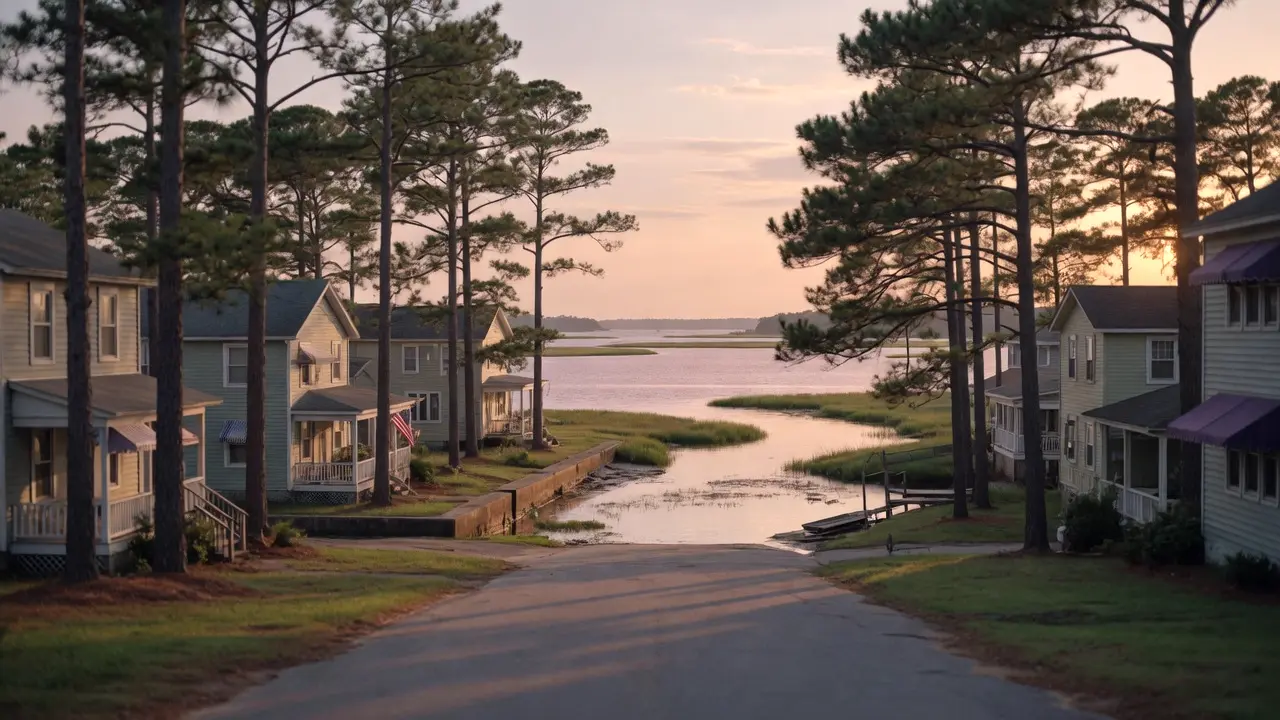
Home services across Hampton Roads
Sharpline Home Services covers home services in Virginia Beach, Norfolk, Chesapeake, Newport News, Hampton, Portsmouth and Suffolk. Plumbing, Heating & Cooling, Electrical, Roofing and the smaller repairs in between. One company, one number, one team accountable for the whole job.
Virginia Beach · Norfolk · Chesapeake · Newport News · Hampton · Portsmouth · Suffolk
What actually breaks here
The housing stock decides the work.
Hampton Roads is crawl space and slab country. The water table sits close to the surface across Tidewater, so builders skipped basements, and that changes the whole failure pattern: a leak soaks joists and subfloor quietly for months instead of pooling somewhere visible. Summer humidity finishes the job, condensing on cool surfaces inside vented crawl spaces and rotting houses that have never once flooded. Salt air corrodes everything outside faster than the same part inland, from condenser coils to hinges to garage door tracks. Tropical season runs June through November, and a coastal storm pushes water uphill under shingles rather than simply falling on them. On top of that, the region spans thirty years of building code inside a twenty minute drive: Norfolk's median home dates to about 1964 and Suffolk's to about 1994, which means galvanized pipe and cast iron drains on one side of the water and polybutylene and well pumps on the other.
Houses here sit on crawl spaces and slabs, not basements. That single fact changes what fails, how you find it, and how long it hides before you notice. Add coastal storm season, salt air and summer humidity, and Hampton Roads houses break in ways a generic contractor site never mentions.
We've spent years keeping apartment portfolios and commercial buildings running, every trade on one schedule, one accountable company. Hampton Roads homeowners get that same setup at the scale of one house.
What we run here
Services available in Hampton Roads
Our service mix differs by market, partly because the housing itself is different.
Plumbing
Galvanized supply lines rusting shut in Norfolk and Portsmouth stock, polybutylene in the Virginia Beach and Chesapeake build era, and slab leaks that show up as a warm floor instead of a puddle.
See plumbing →Electrical
Panels from the 1960s and 1970s in the older cities, aluminum branch wiring in late-60s and early-70s stock, and exterior fixtures and outlets that corrode near the water.
See electrical →Heating & Cooling
Heat pumps outnumber gas furnaces in coastal Virginia, and with this humidity the AC's real job is drying the air. Upstairs rooms that never cool are the region's most common complaint.
See heating & cooling →Handyman
Mounting, assembly, doors and hardware, garage doors, fixture swaps and punch lists. The lowest-commitment way to find out whether you like working with us.
See handyman →Roofing
Storm season runs June through November. Wind-driven rain gets in at pipe boots, flashing and ridge, which is where most Hampton Roads roof leaks actually start.
See roofing →Painting & Drywall
Humidity, closing dates and rental turnovers drive this one. We settle what's leaking above a ceiling before we close it up.
See painting & drywall →Windows & Doors
Coastal wind-borne debris requirements, salt-corroded hardware, and doors that swell shut in August. A door that won't lock means the house isn't secure tonight.
See windows & doors →Foundation Repair
Where crawl space and moisture work lives in Virginia: encapsulation, vapor barrier, drainage and dehumidification, plus joists, girders and sill plates that rotted from underneath.
See foundation repair →Tile & Flooring
Soft or spongy floors near a toilet or dishwasher are the top call here, and they're a leak first and a flooring job second.
See tile & flooring →Something wrong right now?
Most home repair can wait for a scheduled visit. These cannot.
- Water coming in during a storm. Coastal systems drive rain sideways. It gets in at pipe boots, flashing and ridge vents long before a shingle field fails.
- No air conditioning in August. Humidity here turns a dead AC into a health problem quickly, especially for older adults and infants.
- Standing water under the house. On a crawl space that water has nowhere to go except into your joists.
- A door that will not lock. The house is not secure tonight.
If you smell gas or a CO alarm is sounding, get everyone outside first. Call the gas utility or 911 from outside, then call us on 757-769-1181.
Why do Hampton Roads houses break the way they do?
Three things drive most of it: what's under the house, what's in the air, and what month it is.
Almost nothing here has a basement. The water table sits close to the surface across Tidewater, and a basement needs roughly eight feet of excavation, so builders used crawl spaces and slabs instead. That changes the entire failure pattern. A leak under a Norfolk house doesn't pool somewhere you'd see it. It soaks joists and subfloor quietly for months, and the first sign is a musty hall closet or a floor that gives a little near the tub.
Summer humidity does the rest. Warm wet air moves into a vented crawl space, hits cooler surfaces underneath and condenses. That's how houses that have never flooded end up with rot below the floor. Salt air handles the outside, corroding condenser coils, hinges, lock hardware and garage door tracks faster than the same parts age inland. Exterior hardware is a maintenance item here, not a lifetime part.
Then there's the calendar. June through November is tropical season, and a coastal storm doesn't test a roof the way ordinary rain does. It pushes water uphill under shingles and into any penetration that isn't sealed.
Your house and your neighbor's were built thirty years apart
Drive twenty minutes in Hampton Roads and you change building eras. The median home in Norfolk dates to about 1964. Portsmouth is around 1967, Hampton around 1974, Newport News around 1979, Virginia Beach around 1984, Chesapeake around 1989, and Suffolk around 1994.
That spread decides your repair list.
Norfolk and Portsmouth stock brings galvanized supply lines rusting shut, cast iron drains gone brittle, and electrical panels well past the service life anyone planned for. Homes from the late 1960s and early 1970s, which covers a lot of Hampton and older Newport News, are where aluminum branch wiring turns up behind outlets and switches.
Virginia Beach and Chesapeake sit squarely in the polybutylene window. That gray plastic supply pipe went into houses from the late 1970s into the 1990s and fails at the fittings with no warning. Suffolk is newer and more rural, so the calls shift toward well pumps, pressure tanks and long service runs.
Same region, same weather, completely different problems. That's why each city gets its own page instead of one page with the name swapped.
Which services run in Hampton Roads?
Nine of our ten services run here. Basement Waterproofing does not, because Hampton Roads doesn't have basements to waterproof. That work lives under Foundation Repair as crawl space and moisture control, which is the version of the problem you actually have. The basement page is written for South Jersey and Delaware County, where basements are standard.
Anyone trying to sell you basement waterproofing in Virginia Beach has never been under a Tidewater house.
Do you work around PCS dates and closing deadlines?
Yes, and on those jobs the date is the job. Norfolk and Virginia Beach run on orders, and orders don't move because a contractor did.
Three versions come up constantly:
- Pre-listing repair sprints. You have a list and a hard date. We work the list against the date.
- Home inspection punch lists and repair addendums. Nine trades under one company means one schedule, instead of five contractors each waiting on another to finish.
- Turnover on a house you kept. Plenty of people PCS out, rent the place out, and need someone here to reset it between tenants. Getting a unit rent-ready on a fixed schedule is what Sharpline already does at portfolio scale.
There's no military discount here. On a PCS timeline what matters is a date you can hold a closing to, so that's what we talk about up front.
This might actually be a different problem than you think
Homeowners search the symptom. The cause is usually another trade. Four we see constantly in this region:
- A brown stain spreading on a ceiling. Roofing or Plumbing, and where it sits plus whether it grows when it rains tells you which. Painting over it before that's answered just hides it, so Painting & Drywall closes the ceiling last, not first.
- A door that suddenly starts sticking after years of working fine. That's often foundation movement, not a door problem. Windows & Doors and Foundation Repair look at that one together.
- A floor that feels soft near a toilet, a dishwasher or an exterior wall. Over a crawl space that's usually a slow leak and rot underneath. It arrives as a Tile & Flooring question and turns into a plumbing job.
- An AC that runs all day and never catches up. Sometimes it's the equipment. Often it's duct loss in a hot crawl space, or an envelope problem, so Heating & Cooling and Windows & Doors both get a look.
Not sure which one you have? Describe it. Sorting that out is the point of calling one company instead of three.
Where we work in Hampton Roads
Seven cities, and we say seven because that's what's true. Each one has its own page about what actually goes wrong in that housing stock. Smaller jobs across all seven go to Handyman, and Electrical covers the panel and circuit work the older cities keep needing.
Towns we cover
Everywhere we work in Hampton Roads
Common questions
Straight answers.
Do you do basement waterproofing in Hampton Roads?
No. Hampton Roads is crawl space and slab country, so there's almost nothing here to waterproof. The high water table makes basements impractical this close to the coast. The equivalent work is crawl space encapsulation, vapor barrier, drainage and dehumidification, and that sits on our Foundation Repair page.
How do I tell if my house is on a crawl space or a slab?
Look along the foundation wall for vent grilles or a small access door, usually on a side or around the back. Vents plus a floor sitting a step or two above grade mean a crawl space. Low to the ground with no vents and no hatch usually means slab. It matters, because slab plumbing runs under concrete, so a leak shows up as a warm spot on the floor or a meter that keeps turning, not a puddle.
Why does my heat pump run constantly in winter?
Heat pumps outnumber gas furnaces in coastal Virginia because the winters are mild enough for them to make sense. When it gets cold enough, the system falls back on electric resistance heat, and that's what spikes the bill. Constant running plus a high bill usually means the heat pump isn't keeping up, the defrost cycle is off, or the backup heat is stuck on.
What should I do after a coastal storm?
Photograph everything before anything gets moved, covered or cleaned up, from outside and from inside. Then stop the water, because a tarp today is cheaper than a ceiling later. Most Hampton Roads roof leaks start at pipe boots, flashing and ridge rather than in the middle of a shingle field, so tell us where the water shows up inside.
Can one company really cover plumbing, roofing and electrical?
In commercial and multifamily property maintenance that's the normal model, not a stretch. One vendor carries every trade across a portfolio, because a building doesn't care which trade it needs next. Sharpline has run that way for years and is bringing the same setup to homeowners. One number, one point of contact, one team accountable for the whole job.
Do you work with owners who rent out a house here?
Yes. Newport News is only about half detached single-family homes, and plenty of owners across the region rent out a house they kept after moving. Make-ready between tenants, punch lists and repairs coordinated for someone who isn't local are all covered under Property Owners & Managers.