
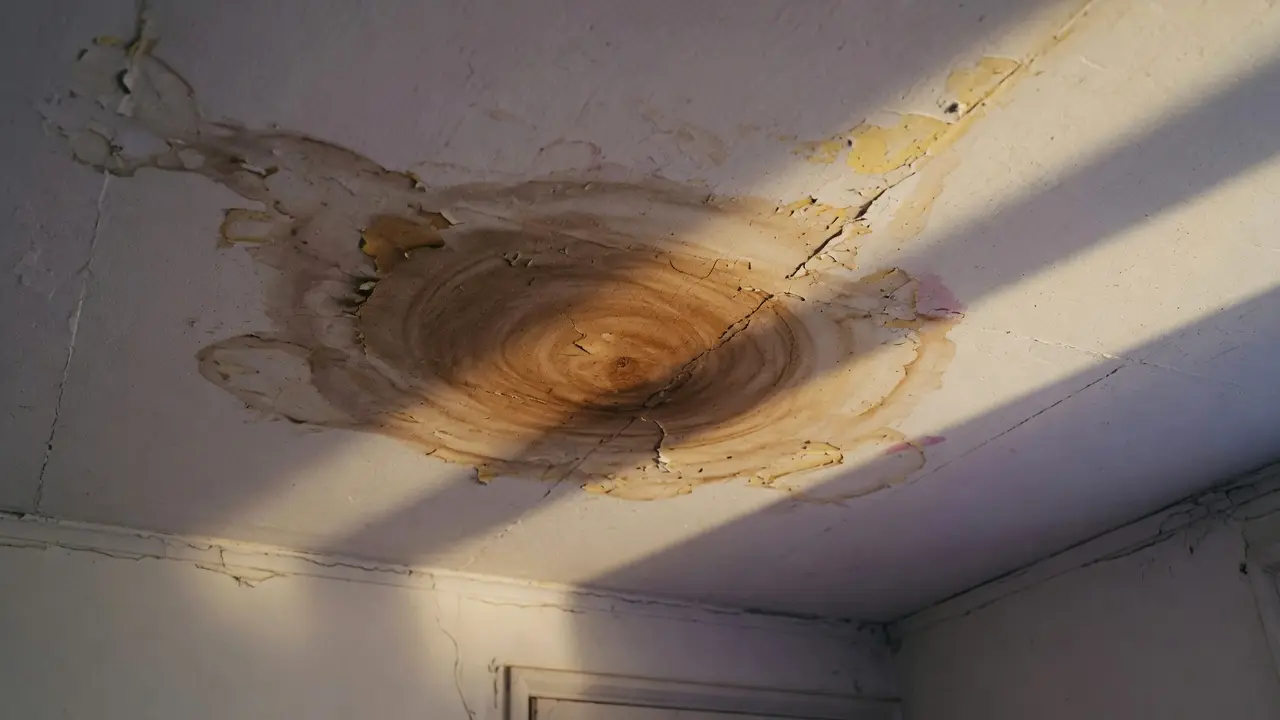
What actually causes a brown stain on a ceiling?
There are three causes, and everything else is a variation on one of them. A roof leak, a plumbing leak, or condensation. The brown color is not dirt sitting on the paint. It is what the water dissolved on the way through, mostly tannins from framing lumber, attic dust, and the glue and paper facing in the drywall. The water evaporates and leaves that material behind as a ring.
- A roof leak. Water gets in at a flashing, a valley, a nail hole, or a cracked pipe boot, then runs along the framing before it drops. This is Roofing work.
- A plumbing leak. A supply line, a drain line, or a failed seal under a toilet or shower above that ceiling. This is Plumbing work.
- Condensation. An uninsulated duct, a clogged condensate drain, or an overflowing drain pan under an attic air handler. Warm humid air hits a cold surface and water forms out of nowhere. This is Heating & Cooling work, and in a Hampton Roads July it is more common than people expect.
Each of those three breaks down into more specific sources, from clogged gutters and ice dams to attic water heaters and bathroom exhaust fans. We walk through them in what causes water damage on a ceiling.
Where in the house is the stain?
Location narrows it faster than anything else you can do. A stain on a top-floor ceiling with nothing above it but attic and roof points at the roof, or at condensation in the attic. A stain on a lower-floor ceiling with a bathroom, kitchen, or laundry room above it points at plumbing first.
One warning before you trust that. Water does not fall straight down. It runs along a rafter, a duct, or the top edge of a joist and drops at the first low point it finds. The stain you see can be several feet from where the water got in. So "I looked right above it and there was nothing there" is completely normal, and it does not clear the roof or the pipe.
- Top floor, no plumbing above: roof, flashing, a vent pipe boot, or attic condensation.
- Directly under a bathroom, kitchen, or laundry: plumbing, until proven otherwise.
- Near an attic air handler or a duct run: condensate line or a sweating duct.
- Hallway ceiling near an exterior wall: could be a roof leak that traveled, or water getting in at a window or the siding.
Does the stain grow after rain, or after a shower?
This is the most useful test you can run, and it costs nothing. Draw a light pencil line around the edge of the stain and write today's date next to it. Then pay attention to what makes it move.
- Grows during or just after rain, especially wind-driven rain from one direction: the roof or the building envelope.
- Grows after showers, laundry, or the dishwasher: a drain line or a fixture seal above.
- Grows steadily whether it rains or not, and whether anyone is home or not: a pressurized supply line. That one does not stop on its own and it does not get better.
- Grows on hot humid days when the AC runs hard, then dries out: condensation.
Give it a few weeks of normal weather before you decide. A slow roof leak can stay quiet through a month of light rain and only show after one storm from the right angle. A single dry week does not prove the roof is fine.
What does the shape of the stain tell me?
The edge of the stain is a record of what happened. A hard brown ring around a lighter center means the area has been wet and dried repeatedly, which fits an intermittent source like rain. A soft, fuzzy edge with no ring usually means it is still wet right now.
- Concentric rings, like a tide mark: repeated wetting and drying over months or years.
- One dark blotch with a blurry edge: active and current.
- Rusty orange dots in a straight line: fastener heads. Often condensation rather than a leak.
- Bubbled or flaking paint, or a ceiling that feels soft to a light touch: the board has taken on water and lost strength.
- A visible sag or bulge: water is pooled up there right now. Treat that as urgent and read the next section before you touch it.
Is a brown ceiling stain mold?
The brown itself is usually mineral and tannin staining, not mold. But wet drywall can start growing mold within a couple of days, so a stain that is still active is a mold question as well as a water question. Black, green, or fuzzy growth is a different problem, and it should be looked at before anything gets painted.
Two things not to do. Do not sand or dry-scrape a ceiling you think has been wet. Do not cut a hole in it and then leave it open with a fan blowing across the house. If someone in the home has asthma or a breathing condition, get it assessed before you start opening things up.
What should you do right now?
Do three things before you call anyone: contain the water, mark the stain, and photograph it. Fifteen minutes of that makes the diagnosis faster and cheaper for whoever ends up coming out.
- Move furniture out of the way and put down a bucket and a plastic sheet.
- Outline the stain in pencil, write the date, and take a photo with something in frame for scale.
- If water is anywhere near a light fixture, a ceiling fan, or a smoke alarm, switch that circuit off at the panel first.
- If the ceiling is bulging, do not wait for it to let go. Put a bucket under it, wear eye protection, stand to the side, and poke a small hole at the lowest point so it drains in one controlled place.
- If you suspect plumbing, shut the supply valve to the fixture above. If you cannot find that valve, shut the main.
- If you can get into the attic safely, take a flashlight and look for wet insulation, daylight around a vent pipe, or beads of water on a duct. Stay on the joists.
- Write down what was happening when the stain showed up. A storm, a long shower, the hottest day of the year. That note is often the whole answer.
Can I just paint over a brown ceiling stain?
No. Painting over a ceiling stain before the cause is fixed is malpractice, and a painter who agrees to it without asking where the water came from is telling you how they work. The stain bleeds back through the new paint within weeks. Meanwhile the drywall behind it keeps getting wet, and the framing above it does too.
The right order never changes:
- Find the cause.
- Fix the cause.
- Let the assembly dry, and confirm it with a moisture meter rather than a hand.
- Cut out and replace any board that is soft, sagging, or coming apart. Board that is dry and only stained can usually stay.
- Prime with a stain-blocking primer, shellac or oil based. Latex primer alone will not hold that stain back.
- Repaint, usually the full ceiling plane, because a spot repair on a ceiling always shows.
That last part is ordinary Painting & Drywall work. It is also the easiest step to do too early, which is why so many people pay for it twice.
Why is a ceiling stain so hard to get fixed?
Because the symptom belongs to one trade and the cause usually belongs to another. You go looking for a painter, because a ruined ceiling is what you can see. The painter cannot fix a roof. The roofer will not open your ceiling or go near a drain line. If the roofer looks and finds nothing, you start over with a plumber, new appointment and new diagnostic charge, still not knowing which one of them is right.
That is the argument for calling one company that covers Roofing, Plumbing and Painting & Drywall. The same company can rule the roof in or out, check the fixtures and lines above the stain, look at the condensate drain, and then put the ceiling back once the water is actually stopped. Nobody spends the visit defending their own trade.
Some of the time, though, the honest answer is that this is not our call to take:
- You rent. This is your landlord's repair. Report it in writing today and keep the photos.
- You are in a condo or a townhouse with a shared roof. The roof is often the association's responsibility, and hiring a contractor yourself first can cost you the claim.
- The water is coming from the unit above yours. That is their plumbing and a conversation between two insurers.
- A pipe has burst and water is pouring in. Shut the main, then call. Diagnosis can wait ten minutes.
When should you call someone about a ceiling stain?
Not every brown stain is an emergency, and pretending otherwise is how people get sold work they do not need. Here is the honest split.
Call now. The ceiling is sagging or bulging. Water is dripping onto or around a light fixture, a ceiling fan, or a smoke alarm. The stain grew several inches in a day. Water is anywhere near your electrical panel. You can hear water running with every fixture in the house turned off.
Call this week. The stain grows after rain, or after showers and laundry. The ceiling feels soft under light pressure. The stain is spreading slowly but it is definitely spreading. Nothing here will flood your house tonight, but every one of these is getting worse and costing more the longer it runs.
It can genuinely wait. The stain is bone dry, it has not changed in a year or more, and you know what caused it and know it was repaired. That is a cosmetic job now. Just do not let "it can wait" quietly turn into "I will paint over it." Confirm it is dry, prime it properly, then paint.
When you do call, tell us where the stain is, what sits directly above it, and what makes it grow. Send the photo with the pencil line on it. If you want to know how we would sequence a job like this, or what we would need to confirm before booking, ask us and we will tell you. You can also reach us through Contact Sharpline.