
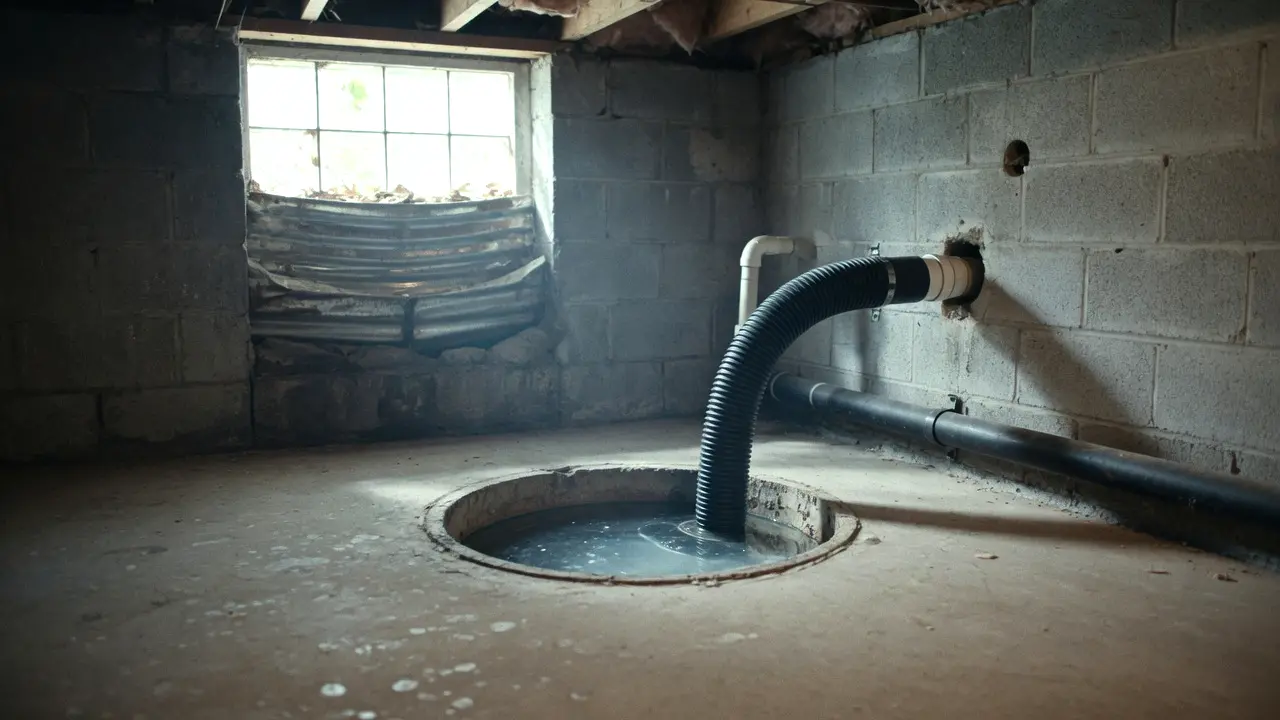
Wet basements start with one question: where from?
You came down the stairs after a storm and the carpet squelched. Or the same corner puddles every March and you have stopped mentioning it. Basement waterproofing in Elkton, MD, Pittsburgh, South Jersey and southeastern PA starts with finding where the water gets in, then fixing that.
South Jersey, NJ · Southeastern PA · Pittsburgh, PA · Elkton, MD
When it cannot wait
Water coming in right now?
Some basement problems can wait for a dry week. These can't. Call 610-550-3248 and tell us what you're looking at.
Water is coming in during the storm and it's still rising
Kill power to anything plugged in down there before you wade in. Standing water and live outlets are the real danger, not the water. Then call us.
The sump pit is full and the pump is silent
A dead pump in a full pit means the finished half of the basement is next. Check the breaker and look at whether the float is jammed against the pit wall, then call.
The power is out and the sump has no backup
Sump pumps run on house power. When the street loses it in a storm, the pit fills at exactly the wrong moment. This is what battery backup exists for.
Water or a sewer smell is coming up a floor drain
That isn't groundwater. Stop running water anywhere in the house and call. On town sewer it's a Plumbing problem. On a septic system, which plenty of Cecil County homes use, the septic may be backing up. No amount of waterproofing fixes either one.
It might not be what you think
This might not be a basement problem at all
Water shows up in a basement for reasons that have nothing to do with the basement. Here's how to tell where your call really belongs. Getting this right is the difference between a repair that holds and one that comes back.
The wall is bowing inward, or the cracks look like stair steps through the block
That's movement, not moisture. Sealing a crack in a wall that's still moving buys you a season. Bowing walls and pier work usually need a licensed structural engineer's stamp before anyone touches them, and we'll say so before we quote anything.
Foundation & Crawl Space RepairYour house is in Hampton Roads and the water is in a crawl space
Basement waterproofing is the work we do in our Maryland, Pennsylvania and New Jersey markets. Almost no house near the Virginia coast has a basement, because the water table starts a few feet down. What you have is a crawl space or a slab. The moisture work is the same idea in a different space, and it lives on a different page.
Foundation & Crawl Space RepairWater shows up when it hasn't rained in a week
Groundwater needs rain or snowmelt to arrive. A wet spot during a dry stretch is usually a supply line, a water heater, a washer hose, a sewer lateral or, on a private well, the pressure tank. That's a leak, and leaks get worse on their own.
PlumbingThe gutters overflow at the same corner every storm
Gutter and downspout work sits with the roof, because that's where the job happens. Getting the discharge away from the wall is frequently the entire fix, and it's the cheapest one on this page.
RoofingThe basement is dry but the whole first floor feels clammy all summer
That's humidity and airflow, not seepage. A right-sized dehumidifier and a system that actually pulls moisture out of the air will do more than any drain will.
Heating & CoolingThe drywall, trim and paint downstairs are ruined
Once the space is dry and staying dry, the damaged board comes out, the base trim goes back and the walls get repainted. Never in the other order. Covering up an unresolved leak is how a small repair turns into a big one.
Painting & DrywallCommon questions
Straight answers.
How much does basement waterproofing cost?
We won't put a number on a web page, because the same wet corner can be a downspout extension or a full perimeter drain. Those are worlds apart, in Elkton, Pittsburgh, South Jersey or Delaware County alike. What we will do is tell you which one you're looking at before you commit to anything.
Does homeowners insurance cover a wet basement?
Usually not for groundwater seepage, which most policies treat as a maintenance issue. A sudden burst pipe or an overflowing water heater is often a different story. Sump pump failure coverage is normally a separate rider you have to ask for. Read your policy or call your agent before you assume either way.
Can you waterproof a basement from the outside instead?
Sometimes that's the right call. Exterior work means excavating down the outside of the foundation wall, cleaning it, membraning it and installing a footing drain. It costs more and it tears up the yard, so it's the answer when the wall itself needs sealing or when interior work isn't practical.
Do I need a permit for a sump pump or an interior drain?
Sometimes, and it depends on where the house is. Sump discharge, new electrical circuits and drainage tie-ins are handled differently from one town, township or county to the next, so a job in Elkton, Pittsburgh, Haddonfield or Media can each come with its own requirements. Where the pump is allowed to discharge is part of that question. We check with your local building office before the work goes on the calendar.
Do you handle mold in the basement?
Mold grows because something stays wet, so the water is the actual fix. Stopping the water and drying the space is what this page describes.
Which areas do you cover for basement waterproofing?
Four markets. In Maryland, Elkton and Cecil County, where homes are a mix of town water and sewer and private well and septic. In western Pennsylvania, Pittsburgh, with its large stock of older houses with basements, many on sloped lots. In New Jersey, South Jersey across Camden County, including Cherry Hill and Haddonfield. In southeastern Pennsylvania, the Delaware County suburbs of Philadelphia, including Media and Havertown.
My basement is dry. Is there anything worth doing now?
Yes, and it's the cheap end of this whole page. Clear the gutters. Get the downspouts discharging well away from the wall. Check that the ground slopes away from the house on every side. Then test the sump pump with a bucket of water. That short list prevents most of the calls we get.
Are you registered to do home improvement work in Maryland, Pennsylvania and New Jersey?
Registration and licensing rules for home improvement contractors are set state by state. Where a state wants the number in advertising, it belongs right here rather than buried in a footer.
Everything we handle
Basement Waterproofing we're called out for
Open any of these for the detail. If you would rather just describe it to a person, call 610-550-3248.
Here's the part most waterproofing companies won't lead with. Plenty of wet basements get fixed outside the house, not inside it, whether the house is in Elkton, Pittsburgh, Cherry Hill or Media. A gutter that overflows at one corner, a downspout emptying at the wall, or soil that has settled back toward the foundation will soak a basement with nothing structurally wrong with it. That's a morning of work with a shovel and some extensions. An interior French drain means breaking up the edge of your floor slab. Those are not the same job, and you should know which one you're looking at before anyone quotes you.
Sharpline came out of commercial and apartment property maintenance, where one company carries every trade and answers one phone. We're bringing that to homeowners in four places where houses have basements: Elkton and the rest of Cecil County, Maryland; Pittsburgh; Camden County in South Jersey; and the Delaware County suburbs of Philadelphia. The drainage, the sump pump, the crack in the wall and the drywall you have to replace afterward all come from the same team. In Hampton Roads, where the water table sits a few feet down and houses are built on crawl spaces and slabs, the same kind of water problem is handled under Foundation & Crawl Space Repair.
Why is my basement wet after it rains?
Rainwater gets into a basement three ways, and each one has a different fix. It comes over the top, as surface water that never got carried away from the house. It comes through the wall, as groundwater pushed through block or poured concrete. Or it comes up from below, where the floor meets the wall. Most wet basements are the first kind. Most homeowners assume they're the second. On a sloped lot, which many older Pittsburgh houses sit on, the uphill wall takes most of the runoff, so the wet side of the basement usually tells you where to look first. Sorting that out costs nothing and changes everything about what the repair looks like.
- a puddle in the same corner after every heavy rain
- a damp line a few inches up the block wall
- white chalky powder on the wall, which means water has been passing through it
- seepage right at the seam where the floor meets the wall
- wet spots around the bulkhead doors or the basement window wells
- rusted appliance feet, soggy cardboard boxes, a musty smell in the stairwell
- a sump pit that fills within minutes of the rain starting
Can gutters and grading really fix a wet basement?
Often, yes, and it's the first thing we look at. A single downspout emptying at the foundation delivers everything your roof just caught, right against your wall. If the ground has settled so it slopes back toward the house, that water has nowhere else to go but down. We'd rather sell you downspout extensions and a few hours of regrading than a perimeter drain you didn't need. New and replacement gutters and downspouts sit with our Roofing work, since that's where the job actually happens.
- gutters that overflow at the same corner or seam every storm
- downspouts discharging at the foundation instead of well away from it
- buried downspout lines that have collapsed, crushed or clogged
- soil that has settled over the years and now pitches toward the house
- window wells with no drain and no cover, filling up like buckets
- a patio, walkway or driveway that has sunk and now drains back at the wall
- garden beds mounded against the siding, holding water at the foundation
What does an interior French drain actually involve?
An interior French drain, also called a perimeter drain, is real construction and not a coating. We break out a strip of the floor slab around the inside of the basement. Perforated pipe goes into gravel below the slab, gets piped to a sump pit, and the concrete goes back. It relieves the water pressure under your floor instead of trying to hold it back. Anyone selling a painted-on sealer as the answer to hydrostatic pressure is selling you a paint job.
- perimeter drain tile set below the slab and piped to a sump pit
- cove joint seepage where the wall meets the floor
- drainage board or vapor barrier on the wall, carried down to the drain
- a new sump pit in a basement that never had one
- dumpster, dust control and slab patch handled as part of the work
- exterior excavation and wall membrane when outside is the right place to fix it
How do I know if my sump pump is about to fail?
Sump pumps fail quietly, and most people find out during the storm. Test yours by pouring a bucket of water into the pit. It should start, empty the pit and shut off cleanly. If it hums without pumping, cycles on and off rapidly, or the discharge pipe bangs hard when it stops, something is wrong now. A pump is the cheapest part of a wet basement. Replacing one on a Tuesday beats replacing your flooring in April.
- a pump that won't start, or runs and never empties the pit
- a float switch jammed against the side of the pit
- a missing or failed check valve, so water drains back and the pump short cycles
- a discharge line that freezes shut in January
- discharge dumping right back at the foundation, or into a septic system, instead of well away from both
- battery backup for the storm that takes your power out with it
- a water alarm, so you hear about it before the carpet does
- a second pump in the pit for a finished basement
Do foundation cracks need repair, or just sealing?
It depends on whether the wall is still moving. A hairline crack in a poured wall that hasn't changed in years is a sealing job, injected with polyurethane or epoxy from the inside, no digging. A crack that keeps widening, a wall bowing inward, or stair step cracking through block joints is movement. Sealing that hides the problem for a season and nothing more. Bowing walls, pier design and anything load bearing usually need a licensed structural engineer's stamp first. We'll tell you that instead of injecting it and walking away.
- poured wall crack injection from the inside
- block wall seepage coming through the mortar joints
- leaking tie rod holes left from the original formwork
- pipe and conduit penetrations that were never properly sealed
- bulkhead and hatchway doors leaking at the sill
- cracks that keep opening, which get a structural look and not a caulk gun
What if part of the house sits over a crawl space?
A lot of older homes are part basement, part crawl, usually because an addition or a back room went on over a crawl space. You'll find that around Elkton, in Pittsburgh, in Camden County and in Delaware County. The crawl is usually the wetter half, and nobody goes down there to find out. Standing water, a torn plastic sheet and rotting joist ends are common. Damp air in a crawl space doesn't stay in the crawl space either. It ends up in the rooms above it, which is why the first floor smells like the basement.
- standing water and no vapor barrier at all
- sealed vapor barrier and full encapsulation of the space
- a dehumidifier sized for the space with a condensate pump
- soft joists, sill plate rot and beam ends that need real repair
- insulation that fell down years ago and now holds moisture
- crawl space waterproofing where a sump makes more sense than a French drain
Why does the basement still smell damp when the floor is dry?
Because humidity is a separate problem from water. Warm summer air hits cool masonry walls, condenses on them, and the whole space stays damp without a drop coming in. That's what makes the smell. It's also what grows mold on cardboard, on stored furniture and on the back of anything pushed against the wall. A drain won't touch it. Air will. If the clammy feeling reaches the first floor too, that's a whole-house job for Heating & Cooling.
- a proper dehumidifier plumbed to a drain, not one you empty by hand
- rim joist air sealing, so outside air stops pouring in at the top of the wall
- a dryer vent discharging into the basement instead of outdoors
- cold water lines sweating onto the floor all summer
- the musty smell that means something somewhere is still wet
Do you call 811 before digging?
Yes, every time. The 811 center in Maryland, PA One Call across Pennsylvania and NJ811 in New Jersey mark the gas, electric, water and communication lines on your property before a shovel or a machine goes in the ground. It's free, and in every state we dig in it's the law. We make the call and we wait for the marks. One catch: 811 marks the utility's lines, not yours. A private well line or a septic tank and field, which a lot of Cecil County lots have, won't get flagged, so we ask where they run before we dig.
- Maryland 811 locate before any exterior dig in Elkton or Cecil County
- PA One Call locate before any exterior dig in Pittsburgh or Delaware County
- NJ811 locate before any exterior dig in South Jersey
- marks honored on site, with hand digging near the flags
Who puts the basement back together afterward?
We do, and that's usually why people call one company instead of three. Once the basement is dry and staying dry, the ruined base trim has to come off, the swollen bottom two feet of drywall has to come out, and the flooring has to be dealt with. Doing any of that before the water is handled is a waste of your money. So we won't do it in that order, even if you ask.
- cut out and replace water damaged drywall and base trim
- repaint the affected walls once the moisture reads normal
- replace warped laminate, buckled hardwood or lifted tile
- reset shelving, a utility sink or laundry hookups pulled out for access
- knock out the smaller punch list items while we're already down there
Where water gets in
These usually turn up in the same conversation.
Where we do this
Basement Waterproofing in your area
Tell us what you're seeing down there and we'll tell you which fix it is.
Call 610-550-3248, or send us a note with a photo of the wet spot.