
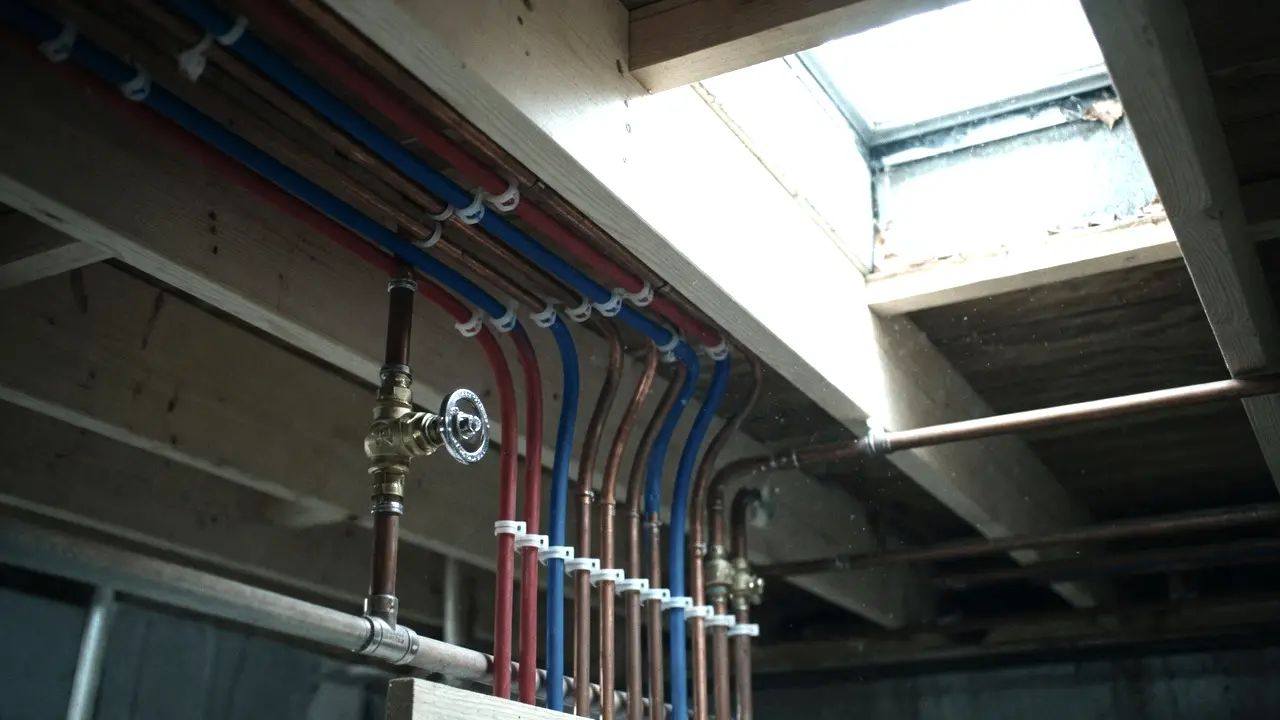
Plumbing repair, from a dripping valve to a burst main
Something is leaking, backing up, or refusing to make hot water. That is usually what sits behind a late-night search for a plumber. Sharpline handles plumbing repair and replacement for homeowners in all five of the markets we serve, from water heaters and burst pipes to drains that keep clogging.
Elkton, MD · Hampton Roads, VA · Pittsburgh, PA · South Jersey, NJ · Southeastern PA
When it cannot wait
Emergency plumbing: four problems that cannot wait until morning
These four do damage by the hour, not by the day. Do the first thing listed, then call 610-550-3248. Water is the one thing in a house that gets more expensive every minute it runs.
A burst pipe, or water running somewhere you cannot reach
Shut the main off first. In a slab or crawl-space house, check the garage wall nearest the street, the crawl space hatch, or the meter box out by the curb. In a house with a basement, look on the basement wall where the line comes in from the street. Turn it clockwise until it stops, then open the lowest faucet in the house to drain the pressure out of the lines.
Sewage backing up into a tub, shower or floor drain
Stop using every drain in the house, including the washing machine. A backup at the lowest fixture usually means the main sewer line is blocked, not that one drain. Anything else you run has to go somewhere.
No hot water, or a water heater sitting in a puddle
A puddle under the tank is a different problem from a drip at a fitting. If the tank body is leaking, close the cold supply valve on top of it and cut the power or the gas. A tank that leaks from the body does not get repaired.
The only toilet in the house is overflowing
Turn the shutoff valve behind the bowl clockwise. If there is no valve, or it is seized, lift the tank lid and push the flapper down by hand. That buys you the time to make the call.
It might not be what you think
This might actually be a roof, foundation or AC problem
Water shows up a long way from where it started. Before you book a plumber, check whether one of these fits better. Getting the cause wrong means paying twice, once for the wrong fix and once for the damage it kept doing while you waited.
A brown ring on the ceiling that grows after it rains
Rain is the tell. If the stain spreads during a storm and not when someone showers, it is coming through the roof, not out of a pipe. Pipe boots, the rubber collars around the vent pipes, are the most common leak point on a residential roof and they fail long before the shingles do.
Roof Repair & ReplacementDamp crawl space, a musty smell, floors that feel soft underfoot
If the ground under the house is wet but no pipe is leaking, that is groundwater and grading, not plumbing. Left alone it rots joists and girders. By the time the floor feels soft, it has stopped being a moisture problem and started being a structural one.
Foundation & Crawl Space RepairWater dripping near a ceiling vent, or pooling around the indoor AC unit
That is usually a blocked condensate drain on the air handler, not a plumbing leak. In a humid summer the pan fills fast and then it finds the ceiling below it. Book it as an HVAC visit and the pipes stay dry.
Heating & CoolingThe ceiling or wall we had to open up to reach the pipe
Once the leak is fixed, someone still has to patch, tape, texture and paint. Never let anyone close a wall over a leak that has not been resolved first. Here it is the same company on the same job, so you are not waiting on a second contractor to finish the hole.
Painting & DrywallA wet basement after rain, with no pipe leaking
Basements are standard in Pittsburgh, South Jersey and southeastern Pennsylvania, and rare in Hampton Roads. If yours takes water at the wall or along the cove joint, that is drainage and grading, not a burst pipe. Check the gutters and downspouts before anyone quotes you an excavation.
Basement WaterproofingA small job you do not think is worth calling a plumber for
Swapping a faucet, a fill valve or a shower head at an existing connection sits inside handyman scope. Same company, smaller visit, and you can stack four or five of them into one appointment.
Handyman ServicesCommon questions
Straight answers.
Do you charge for a plumbing estimate?
This page will not guess at a number. Call 610-550-3248 and you will get the real one before anyone is dispatched.
How fast can someone get out to me?
We are not going to publish a response time we cannot hold to. Tell whoever answers what is happening and whether the water is off, and you will get a real window instead of a marketing one.
Where is the main water shutoff in my house?
It depends on how the house is built. Slab and crawl-space houses, which make up most of Hampton Roads, usually have it on the garage wall nearest the street, just inside the crawl space hatch, or in the meter box near the curb. Basement houses, the norm in Pittsburgh, South Jersey and southeastern Pennsylvania, usually have it on the basement wall near the front, where the line comes in. On a private well, which some Cecil County homes around Elkton use, check near the pressure tank as well. Find yours on a dry day. Hunting for it while water is running is the wrong time to learn.
My drain clears when it gets snaked, then blocks again. Why?
Snaking punches a hole through the blockage rather than removing what causes it. Roots grow back, grease re-coats the pipe, and a cracked or bellied line keeps catching debris. A camera inspection tells you which one you have. Then you fix the line once instead of buying the same visit every few months.
Should I repair or replace my water heater?
Repair it if the failure is a part and the tank itself is sound: elements, thermostats, thermocouples, valves. Replace it if the tank body is leaking, because a rusted-through tank cannot be repaired. Age matters too. If the unit is near the end of its service life and the repair costs a big share of a new one, you are paying twice.
Do you do gas lines?
Gas work is licensed and permitted separately from plumbing in some jurisdictions, so it does not come bundled with a plumbing visit. Tell us it is gas when you call. If you smell gas right now, leave the house first, then call the gas utility or 911.
How do I know if I have polybutylene pipe?
Look at the pipe coming out of the water heater, or the line feeding the shutoff under a sink. Polybutylene is gray, sometimes blue or black, flexible plastic, often stamped PB2110. It went into houses built from the late 1970s into the mid 1990s, so any house from that window is worth checking. Get it looked at before it fails, not after.
Can you replace a sewer line, or only clean it?
That is a scope question, not a different company. A camera inspection comes first, because it decides between a spot repair, a liner and a full replacement. Digging in a yard needs a utility locate before anyone breaks ground. 811 is the national call-before-you-dig number, the locate is free, and nobody should dig without it.
Is a slow drain worth calling about, or should I wait?
Call while it is still slow. A partial blockage is something you can schedule around. The same line at a full stop on a Sunday is an emergency call with a bathroom you cannot use. The work is much the same either way. The timing is the part you control.
Which areas do you cover for plumbing?
Five markets: Elkton and Cecil County in Maryland, Hampton Roads in Virginia, Pittsburgh, South Jersey including Camden County, and southeastern Pennsylvania across the Philadelphia suburbs and Delaware County. If you are not sure your town falls inside one of them, call 610-550-3248 and ask before you book.
Everything we handle
Plumbing we're called out for
Open any of these for the detail. If you would rather just describe it to a person, call 610-550-3248.
We spent years keeping apartment buildings and commercial properties running. Every trade, one number, one company that owns the outcome. Plumbing was never a side line in that work. It was the call that came in first and had to be closed on the same visit. Sharpline Home Services brings that same setup to houses.
This page is organized the way plumbing actually goes wrong. Emergencies first. Then the jobs you can book for next week. At the bottom there is a short section on the problems that look like plumbing and are not, because getting that wrong costs you twice.
Why is there no hot water?
Usually it is the water heater, and what failed decides whether this is a repair or a replacement. On an electric tank it is often a heating element or a thermostat, and both get replaced. On a gas tank the pilot assembly or the thermocouple is the common one. A tank rusting through at the seam is a replacement. We will say that rather than sell you a part that will not hold.
- No hot water at all, or hot water that runs out after a few minutes
- Water heater repair for rusty water, or a rotten-egg smell from the hot tap only
- Water pooling under the tank, or a rust ring on the floor around it
- Popping and rumbling from the tank (sediment on the bottom, making the burner work harder)
- Tankless unit throwing an error code or cycling on and off
- Water heater replacement, including tank to tankless and moving a heater out of a closet
- Expansion tank, temperature and pressure relief valve, and drain pan work on the same visit
What makes a drain keep clogging after you clear it?
A drain that blocks again within weeks is not really clogged. It is damaged, or something further down the line is catching debris. Roots, grease, a bellied section and old cast iron all behave this way. A camera down the line shows which one it is. That is the difference between one spot repair and paying for the same visit over and over.
- Kitchen sink draining slowly, or backing up into the other side of the sink
- Tub and shower that gurgle when the toilet flushes
- Drain cleaning that clears the line instead of punching a hole through the blockage
- Sewer camera inspection to find roots, a collapse or a bellied section
- Hydro jetting for grease and scale, rather than another pass with a cable
- A cleanout added so the line can be worked on without pulling a toilet
- Cast iron and galvanized drain lines in older houses, including Pittsburgh's older basement stock
How do you find a leak you cannot see?
Start at the water meter. Shut every fixture off, watch the meter for fifteen minutes, and if the dial is still moving you are losing water somewhere. After that it is a process. Isolate the hot side from the cold, listen at the fixtures, then check the crawl space or the basement ceiling. Open the smallest piece of wall or ceiling that answers the question.
- A water bill that jumped with no change in how you use water
- A warm or damp patch on a slab floor, which usually means a hot-water slab leak
- Leak detection before the drywall comes down, not after
- Pinhole leaks in copper, or a joint that keeps weeping
- A pipe that split in a freeze, including crawl space and attic runs
- Shutoff valves that no longer shut anything off
- Burst supply hoses behind a washing machine or under a sink
Faucets, toilets and garbage disposals
Most fixture work is a single-visit job at an existing connection. A toilet that runs. A faucet that drips. A disposal that hums and will not turn. These are the smallest plumbing calls there are, and they are the ones people put off longest. If you have three or four of them saved up, group them into one visit.
- Toilet repair for a bowl that runs, rocks, or will not stop filling
- Dripping or seized kitchen and bathroom faucets
- Garbage disposal that hums, jams or leaks underneath
- Shower valve and cartridge replacement, including the scald guard setting
- Ice maker and dishwasher supply lines
- Laundry box and washing machine valves
- Bidet seats, filtered taps and pot fillers at an existing supply
Sump pumps, crawl space and basement water
In Hampton Roads the water problem is almost always under the house, in a crawl space that sits close to the water table. In South Jersey and southeastern Pennsylvania it is usually a basement pit, and the same goes for Pittsburgh, where many older basement houses sit on sloped lots. Either way, a pump that fails during a storm turns into standing water, wet insulation and rot in the framing above it. Test yours by pouring a bucket into the pit. If it does not kick on, that is the whole test.
- Sump pump that runs constantly, or will not kick on at all
- Sump pump installation and replacement, float switches and check valves
- Battery backup for the storm that takes the power with it
- A discharge line that dumps too close to the house, or freezes shut
- Standing water in the crawl space or basement after heavy rain
- Perimeter drainage and a French drain feeding the pit
Do I need to repipe the house?
Two materials turn that into a yes. Polybutylene is the gray or blue flexible plastic pipe used from the late 1970s into the mid 1990s. It has a long record of failing from the inside out. Galvanized steel corrodes closed until your pressure drops to a trickle. If you have either one and you are patching leaks on repeat, you are not fixing a problem, you are renting time.
- Identifying polybutylene, galvanized steel or aging copper in your house
- Whole-house repipe in PEX or copper, room by room or all at once
- Repiping through a crawl space or an unfinished basement without tearing up finished floors
- The main water line from the meter to the house
- Hose bib and exterior line replacement while the walls are open
- Drywall and paint handled after, so one company closes the wall back up
Why is my water pressure so low?
Low pressure everywhere in the house points at one of three things: the pressure reducing valve, the main line, or corroded galvanized pipe. Low pressure at a single fixture is nearly always an aerator or a cartridge, and that is the small one. Pressure that runs too high is the problem nobody calls about, and it is why water heaters and supply hoses fail early.
- Pressure reducing valve testing and replacement
- Fixtures that hammer or bang when you shut a tap
- Well pump and pressure tank work for homes on a private well, in parts of Cecil County and out toward Suffolk
- Whole-house filters and softeners plumbed in at the main
- One weak shower while the rest of the house is fine
- Pressure loss that showed up right after a repair somewhere else
Outdoor spigots, hose bibs and freeze damage
How a pipe freezes depends on where the house is. Coastal Virginia does not freeze often, and that is exactly why pipes there split when it does: the hose bib has no frost-proof stem and the crawl space run has no insulation. Houses in Pittsburgh, South Jersey and southeastern Pennsylvania are built for winter, so the failures come from the exceptions, like a frost-proof sillcock with a hose left on it or a supply line run along a cold outside wall. One hard January night finds every weak point at once. The damage usually shows on the first warm day, when the ice thaws and the split starts running.
- A split hose bib, or a spigot that leaks inside the wall when you open it
- Frost-proof sillcock replacement
- Insulating and heat taping exposed crawl space and attic runs
- An irrigation backflow preventer that cracked over the winter
- Winterizing a house you are leaving empty for a move, a sale or a long trip
- Outdoor shower, pool fill and garden line repairs
Is a gas water heater a different job?
Often, yes. Gas work is licensed and permitted separately from plumbing in some jurisdictions, and the two do not automatically travel together. Tell us it is gas when you call, so the visit gets booked against the right trade. The water side of a gas heater is plumbing either way.
- Water side work on a gas heater: supply, temperature and pressure relief valve, drain pan, expansion tank
- If you smell gas right now, leave the house and call the gas utility or 911 before you call us
Where we work
Sharpline takes plumbing calls in five markets, and the work changes with how the houses are built more than with the map. A slab or crawl-space house hides its leaks under the floor. A basement house puts the main shutoff, the sump pit and most of the supply runs in one room you can walk into. A house on a private well adds a pump and a pressure tank to every no-water call.
- Elkton, MD: Cecil County homes on town water and sewer, or on a private well and septic
- Hampton Roads, VA: mostly slab and crawl-space houses, with the oldest drain lines in Norfolk and Portsmouth
- Pittsburgh, PA: a large stock of older houses with basements, many on sloped lots
- South Jersey, NJ: Camden County and the towns around it, where basements are standard
- Southeastern PA: the Philadelphia suburbs and Delaware County, also mostly basement houses
Where water gets in
These usually turn up in the same conversation.
Where we do this
Plumbing in your area
Tell us what is leaking, backing up or refusing to heat.
Call 610-550-3248, or send it through the form and we will book it against the right trade.