Electricians, plumbers and AC repair in Mt. Lebanon
One number for plumbing, electrical, heating & cooling, roofing, handyman work and more in Mt. Lebanon.
Part of our Pittsburgh service area · median home here was built around 1953
What breaks in Mt. Lebanon
The age of the housing decides the work.
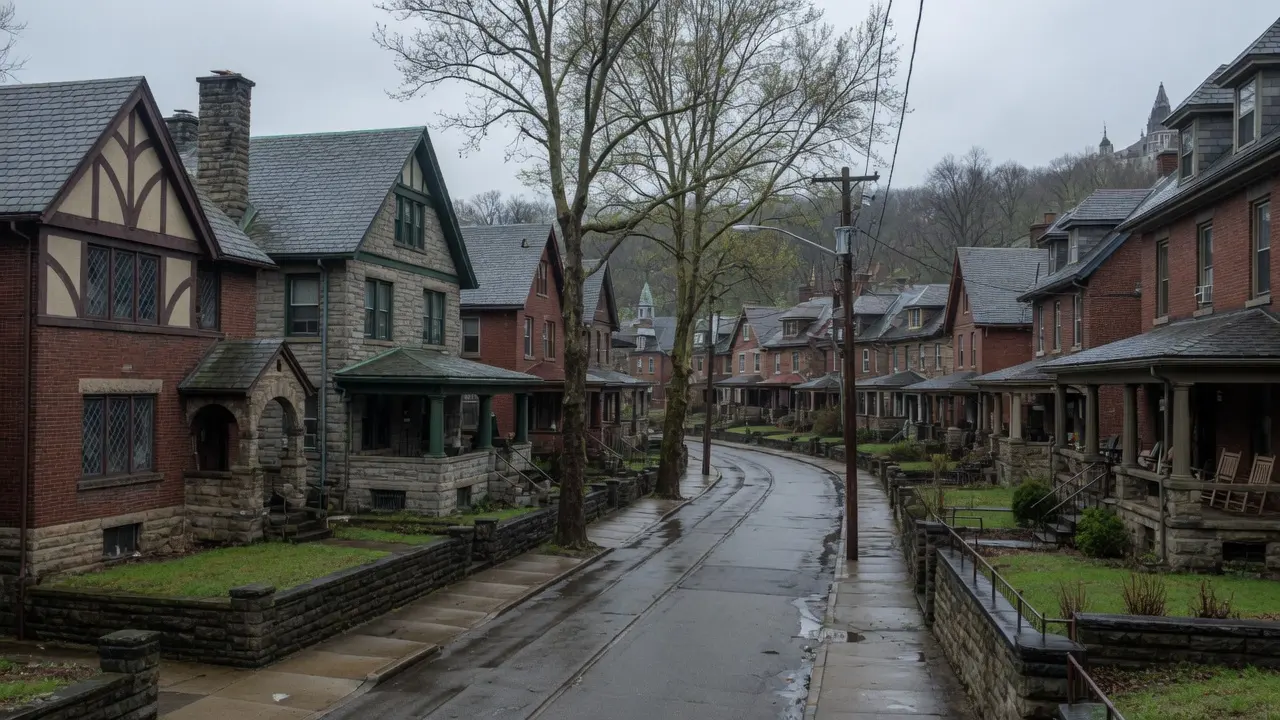
Sixty-five percent of Mt. Lebanon's housing units were standing before 1960 and nearly a third before 1940, which puts the median build year at 1953 and leaves under four percent of the stock built this century. That age decides what is behind the wall. A house from those decades was designed around a boiler, not around moving air, and anything to do with cooling came later. Sitting over all of it is a sale rule: since November 1, 2004 it has been unlawful to convey a property here unless the seller first delivers the buyer Evidence of Compliance, or Interim Evidence of Compliance, issued by the municipality on the certification of a plumber registered and licensed by Allegheny County. Refinancing without a conveyance is exempt.
The dye test is the seller's job, not the municipality's
Mt. Lebanon does not perform the test and does not schedule it. The owner hires it out, and what the municipality issues afterwards is the Evidence of Compliance the sale cannot close without. That inverts the usual order of a house sale. The condition of a downspout connection nobody has looked at since the house was built becomes an item on the closing calendar, and it is the seller who has to find that out early enough to do anything about it.
Five bodies, one house
Nothing about a Mt. Lebanon house is administered in one place. Building permits and the certificate of occupancy come from the municipal inspection office, and no building may be occupied until that certificate issues. Plumbing inspections belong to the Allegheny County Health Department's Bureau of Environmental Health. Electrical is signed off by Middle Department Inspection Agency. The sewer charge is collected by Jordan Tax Service, and the water by Pennsylvania American Water rather than an authority. Five bodies on one address, and the one that holds a closing is not the obvious one.
What the grading chapter does to a dig
A geologic hazard area in Mt. Lebanon is any slope of twenty percent or more, or ground above abandoned mining. A grading permit is required once a dig is both deeper than three feet and larger than 1,000 square feet, or cut steeper than four horizontal to one vertical. A one-family house site has its own volume exemption instead, 100 to 250 cubic yards depending on lot size. On a hazard site, a Geologic Hazard Investigation Report sealed by a geotechnical engineer is mandatory, which turns a foundation dig into a filed project.
The municipality bills the rain, then fines you for it
Mt. Lebanon bills a stormwater fee per equivalent residential unit on a published escalator: $11.39 a month in 2026, $12.81 in 2027 and $14.42 in 2028. That pays for more than 75 miles of separate storm sewer and over 2,500 catch basins, which is the system a downspout is supposed to be in. The teeth are on the other side. Correction work the municipality has to do itself becomes a municipal lien, and a violation carries a fine of up to $300, with every day counted as a separate offense.
What we run in Mt. Lebanon
What actually gets called in the most here
Electrical
12,810 of Mt. Lebanon's 14,640 housing units went up before 1980 and only 577 this century, so the service and branch wiring under most of the municipality were sized against a much smaller load than a house carries now. Inspection adds a step: electrical work here is signed off by Middle Department Inspection Agency, a third-party firm, not by the municipal office that issued the permit.
See electrical →Heating & Cooling
On a boiler-and-radiator house here the cooling is a later addition sitting in an attic or a basement framed for something else. That puts the weight on where the air handler sits, how the returns were cut in and where the condensate ends up, rather than on the equipment itself.
See heating & cooling →Plumbing
Mt. Lebanon is one of 83 ALCOSAN communities under an Allegheny County Health Department consent order, which entered a new phase in 2021 requiring another ten percent cut in the groundwater reaching the sanitary sewer. That is the pressure behind the point-of-sale dye test, and it lands on a stock plumbed when downspouts and driveway drains were routinely tied into that sewer.
See plumbing →We cover the other trades in Mt. Lebanon too — all ten services. Not sure which one it is? Describe the symptom and we will work out the cause.
On the ground in Mt. Lebanon
4,498 of Mt. Lebanon's housing units predate 1940 and another 1,915 date to the 1940s; the 1950s added 3,140 more. That split is what decides the material in the walls. Those three cohorts sit in blocks rather than spread evenly across the municipality, so the decade a street went up is what separates a Mt. Lebanon job that ends at a fixture from one that ends at the main. Nothing on the front of either house says which.
Solid waste is billed on its own line, at $345 per residential unit in 2026, rising to $375 in 2027 and $410 in 2028. A sump pump is its own permit here, and the discharge has to land more than ten feet from the property line and from the municipal right of way; since 2021 a new installation has to reach the storm sewer where that is possible, or an absorbent surface such as grass, mulch or soil where it is not. The ten-business-day filing window counts backwards from the closing date, which makes the dye test the first thing on a Mt. Lebanon sale calendar rather than the last.
Mt. Lebanon questions
Straight answers for Mt. Lebanon.
What is Evidence of Compliance, and when is it due in Mt. Lebanon?
Yes. Mt. Lebanon's code makes it unlawful to sell or convey an improved property without first delivering Evidence of Compliance, or Interim Evidence of Compliance, to the buyer, and that evidence follows a passed dye test. The ordinance took effect November 1, 2004. The test has to be performed by a plumber registered and licensed by Allegheny County, not by a general home inspector, so ask for that registration before you book it. The application and its $50 fee are due at public works at least ten business days before the closing date, and a pass stays valid for three years.
Can I still close if the dye test fails, or if weather stops it?
The plumber reports the failure straight to the Mt. Lebanon Inspection Department, and the correction must be approved there. If weather blocks the test or the repair cannot be finished in time, the seller can apply for Interim Evidence of Compliance at least fourteen business days out. It is granted at the municipality's sole discretion on a $200 fee, and the security is a $200 certified check when weather is the obstacle, or the full amount of the repair contract when a defect was found. It expires in six months, and violations, open permits and dye test requirements must clear before the municipal claims and tax certification letters are released.
My drain is backing up. Do I call the municipality or a plumber first?
The municipality, and it asks you to. Mt. Lebanon tells residents to have public works check whether a blockage is in the municipal line before paying a plumber to look at it, which is the opposite of the usual order and worth doing before you pay anyone to look at it. It also runs a yearly herbicide root treatment on the sanitary sewers on a published street schedule, so a backup that arrives every spring on the same block is worth checking against that schedule before anybody digs. If it does turn out to be on your side, the lateral is yours from the house to the main.
Who pays to replace a lead water service line in Mt. Lebanon?
Pennsylvania American Water, which supplies drinking water here as an investor-owned utility rather than a municipal authority. It replaces customer-owned lead service lines at no direct cost to the homeowner and does the work itself. Its program partner CDM Smith canvasses door to door to identify lead and galvanized steel service lines, and a homeowner can book an inspection instead of waiting to be canvassed. The same company has announced main replacement inside Mt. Lebanon under an $8.6 million South Hills program, including Vermont and Roycroft avenues, Richland Road and Lindenwood Avenue, and Lakemont and Kurt drives.
Nearby