
AC repair, plumbing and electrical in Penn Hills
One number for plumbing, electrical, heating & cooling, roofing, handyman work and more in Penn Hills.
Part of our Pittsburgh service area · median home here was built around the late 1950s
What breaks in Penn Hills
The age of the housing decides the work.
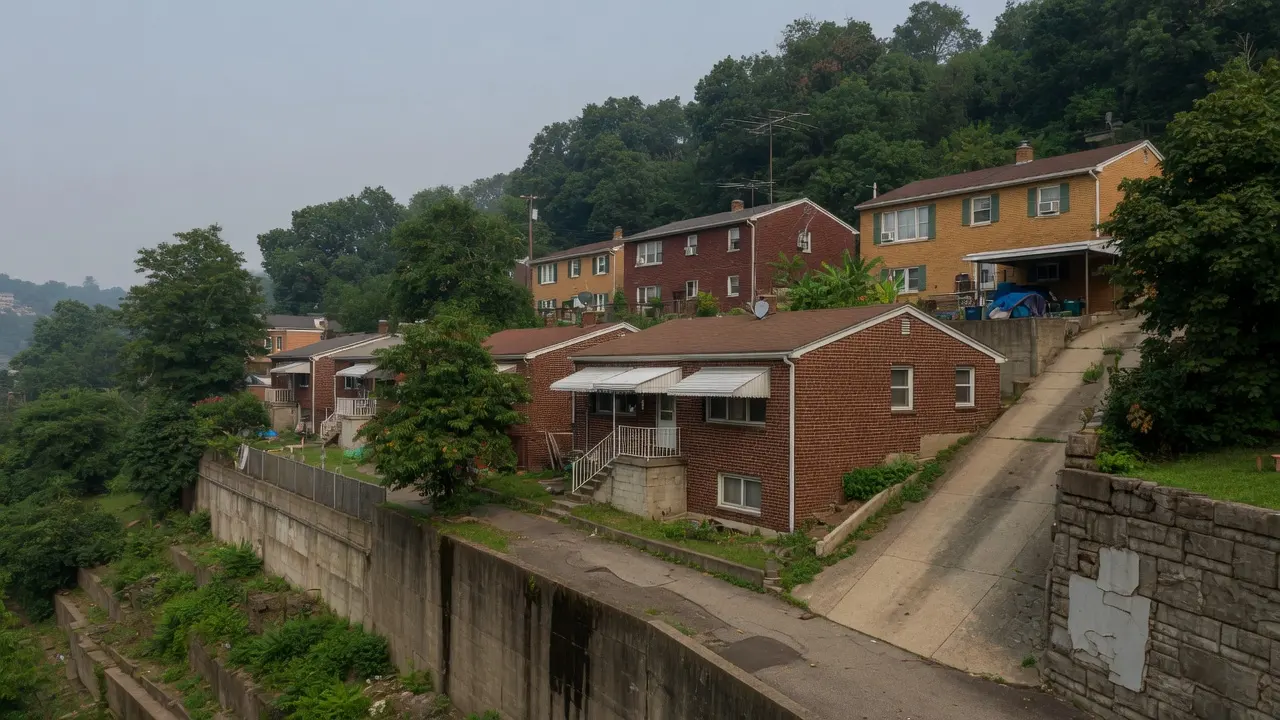
Penn Hills went up in one go. Of 20,261 housing units, 7,220 landed in the 1950s alone, 35.6 percent of the stock in a single decade, and 57.5 percent of it was already standing before 1960. Nearly 90 percent predates 1980. A cohort that tight ages out together: the pipe, the venting and the wiring on one street all reach the end of their span inside the same few years, so the failures land together rather than one trade at a time. Then there is what the houses are standing on, which in Penn Hills is not a settled question.
The ground under Penn Hills has moved
Two things here are ground, not house. Mine subsidence opened a sinkhole in the 2800 block of Laketon Road in March 2015 and shut the road to through traffic with no date set for repairs. Rain did the other one: a landslide condemned three houses on Bramble Street in March 2018. Hollowed-out ground and saturated ground are opposite problems that arrive at the same basement wall, which is why a new crack here is a cause question before it is a repair question. Get that wrong and the repair is paid for twice.
Nobody works here without registering first
Ground work is where Penn Hills' registration rule bites. No contractor may perform any work in the municipality without registering annually with the Department of Code Enforcement, at $25 on the current registration form, and the code defines a contractor as anyone working for a fee on anything that needs a building permit, a street opening permit or a sanitary sewer tap-in permit. The municipality is explicit that the registration is not a license to perform work and does not replace any other license or permit. Grading and street opening are separate permits.
The form on the website is not the form
Penn Hills tells sellers the occupancy permit form posted on its website is a sample and will not be accepted. The real application is a three-part carbonless form you collect in person at Code Enforcement on Duff Road. Resale inspections run Monday to Friday between 9:00 a.m. and 2:00 p.m., on the hour, and somebody has to be there to let the inspector in. The inspection itself usually takes under half an hour, and the write-up and the permit generally come back on the spot.
Roof water and driveway water are the whole test
The dye test form has exactly two pass or fail lines on it, number of downspouts and driveway drain, so the certificate a seller needs is a registered plumber's statement that the property has no storm water connections to the sanitary sewer. ALCOSAN names Penn Hills and Pittsburgh as the two largest of its 83 municipal customers in Allegheny County. Separately, the municipality charges a $20 annual stormwater management service charge on all developed property, billed quarterly, and it counts roofs, patios, driveways and sidewalks as impervious surface.
What we run in Penn Hills
What actually gets called in the most here
Heating & Cooling
Penn Hills makes heating a resale item. The punch list requires furnaces, fireplaces and other heating devices to be properly installed and vented, wants the water heater vent repaired or replaced where it is bad, and puts a carbon monoxide detector near the gas furnace and the hot water tank. On this stock that is a venting conversation before it is an equipment one.
See heating & cooling →Plumbing
The dye test is the seller's to arrange, and the punch list says municipal inspectors will not routinely dye test sewers or septic systems. The homeowner picks the plumber. Penn Hills asks that you hire one registered in Allegheny County, and the ordinance lets the Director of Code Enforcement approve the plumber or other agent who performs it. The plumber gives the municipality two working days' notice so an agent can witness the test.
See plumbing →Electrical
Penn Hills' resale list reads as a retrofit list for pre-1960 wiring. GFCI protection is required near laundry and bathroom sinks, above all kitchen counters and at every exterior outlet, with frayed cable and missing receptacle covers as named line items. After ten plus years of occupancy permit inspections, Penn Hills published its list of typical problems, and missing smoke detectors head it. Detectors are required in each bedroom and on each level.
See electrical →We cover the other trades in Penn Hills too — all ten services. Not sure which one it is? Describe the symptom and we will work out the cause.
On the ground in Penn Hills
Penn Hills describes itself, in its own resale document, as a bedroom community whose tax base is the single-family home, and the housing numbers are blunt about it. The 1950s and 1960s together are 57.6 percent of every unit in the municipality. Construction fell off after 1979 and has effectively stopped since 2000, which added 513 houses, 2.5 percent of the stock. Even the water is not one thing here: the municipality's own sewer page names both Wilkinsburg Penn Joint Water Authority and Oakmont Water Authority, so which utility you call depends on which part of Penn Hills the house sits in.
The punch list is not one trade's list. It carries a handrail on any flight of four or more risers, balusters no more than four inches apart where the fall is thirty inches or greater, a solid core door between an integral garage and the basement, and address numbers four inches tall. Penn Hills also says an inspector can write up a violation of any municipal code, so the published list is a floor rather than a ceiling. An automatic garage door opener gets tested for whether it reverses, and pools are checked against fencing and safety requirements.
Penn Hills questions
Straight answers for Penn Hills.
A crack has opened in my basement wall. How do I tell whether the ground moved?
Start with what is under the property rather than with the wall. PA DEP publishes a mine subsidence risk map at gis.dep.pa.gov/msiRisk that takes an address, coordinates or a municipality, so a parcel-level answer exists before anyone specifies a fix. Subsidence is the collapse of an underground coal or clay mine taking the surface down with it. A landslide is the hillside itself moving, and rain drives it, so when the crack appeared relative to the weather is part of the answer.
Do I need a permit, and does my contractor have to register with Penn Hills?
Yes to both on most jobs. Penn Hills names the work that needs a building permit: new or replacement roofs, solar panels, water and wastewater lines, fences, driveways and sidewalks, pools, generators and accessory buildings over 100 square feet. Its inspector punch list puts the trigger at $2,000 or more of fair market value and its own FAQ words the threshold differently, so ask Code Enforcement on Duff Road before assuming a job is too small to need one. Registration is the other half: it is annual, it is required before any work that year, and grading, street opening and storm sewer tap-ins are permits of their own.
Is the dye test discretionary in Penn Hills, or does every sale get one?
Yes. Penn Hills' own FAQ says an occupancy permit and a dye test are both necessary to buy and sell a house, and its resale punch list treats the dye test as non-discretionary on single-family homes rather than something triggered by suspicion. The occupancy permit fee is $75 for a single-family dwelling, and the dye test carries a $25 filing fee when the passing form is submitted. The ordinance puts the burden on the current owner before the transfer, and the application has to be in at least seven days before the date of sale.
Which repair does Penn Hills accept after a failed dye test?
No document of certification is issued until the illegal connection or malfunctioning drainage system is removed or repaired, retested and recertified by a registered licensed plumber. That is the part that moves a closing date, because the ordinance makes it unlawful to sell improved real estate in Penn Hills without delivering that certification to the buyer. The form names four remedies plus an other line: drain it to the surface, drain it to the municipal storm sewer, drain it to a sump, or repair and replace the lateral. Which one applies depends on where the water currently goes.
Nearby