
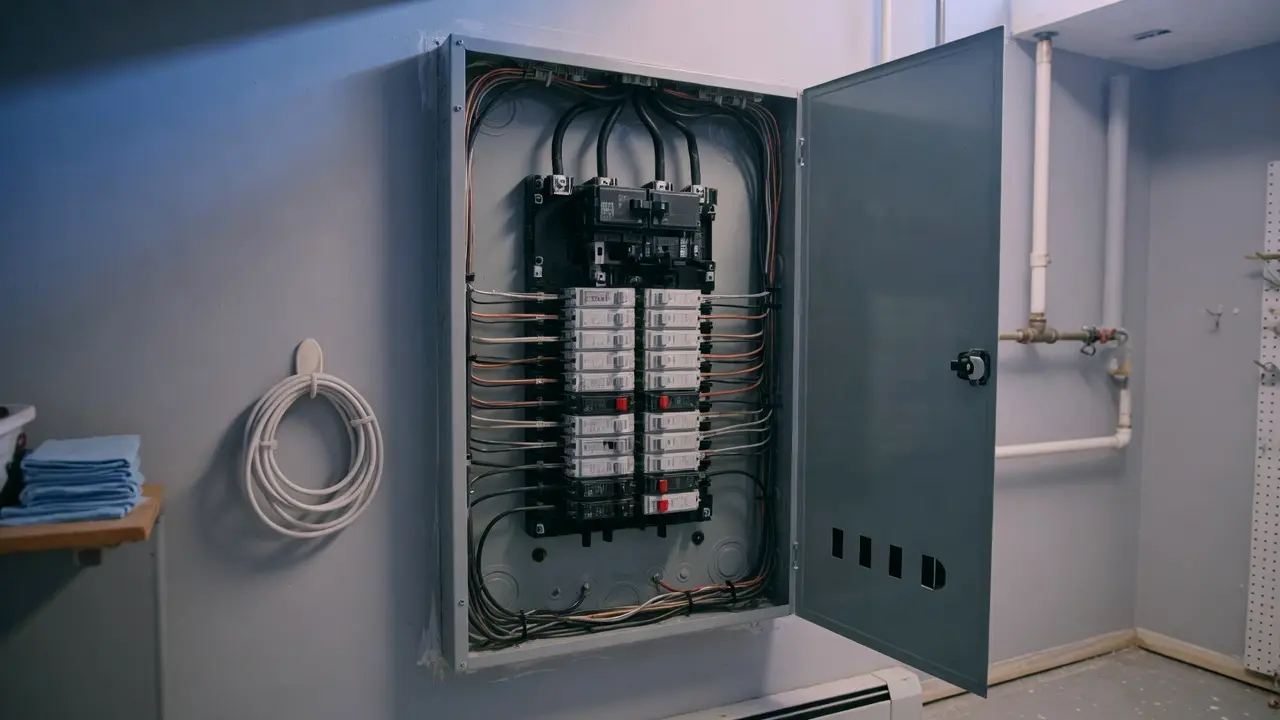
Electrical work that starts by finding the fault
Electrical problems rarely announce themselves politely. A breaker that keeps tripping, an outlet warm to the touch, half the house dark after a storm. We work on panels, circuits and fixtures in five markets, Elkton, Hampton Roads, Pittsburgh, South Jersey and Southeastern Pennsylvania, and we find the cause before we quote the fix.
Elkton, MD · Hampton Roads, VA · Pittsburgh, PA · South Jersey, NJ · Southeastern PA
When it cannot wait
Electrical problems that shouldn't wait until next week
These are fire and shock risks, not inconveniences. If you're seeing any of them, shut the circuit off at the panel if you can do that safely, then call 610-550-3248 and say what you're looking at. If it's after hours, mention that when you call.
You smell burning plastic, or there are scorch marks around an outlet or a switch
That's heat where no heat belongs, usually a loose connection arcing inside the wall. Stop using the circuit and turn it off at the breaker.
An outlet, a switch or the panel is sparking or buzzing
One small blue flash as you unplug something is normal. Repeated sparks, a buzz, or a panel that hums are not.
Half the house went dark and the neighbors still have power
That usually points at one leg of the incoming service, the main breaker, or a failed connection inside the panel. Resetting breakers won't fix it.
A breaker trips again the second you reset it
The breaker is doing exactly what it's for. Something on that circuit is shorted or badly overloaded, and forcing it back on is how fires start.
The panel got wet, or the house took on water
Call the power company first and have the service cut at the meter. Nobody opens an energized wet panel, including us.
It might not be what you think
This might actually be a heating, plumbing or roofing problem
Electrical symptoms lie. Here's how to read the common ones before you book the wrong trade, and where each one usually leads.
The breaker trips every time the air conditioning starts
A compressor drawing too much current on startup will trip a perfectly healthy breaker. The breaker is usually telling the truth about the condenser, not about itself. Worth testing the equipment before anyone rewires anything.
Heating & CoolingWater is dripping from a light fixture, or the fixture is ringed with a brown stain
That's a leak that found the easiest hole in the ceiling. Kill the circuit first, then go find the water. It's almost always the roof above it, or a bathroom on the floor above.
RoofingNo hot water, and the water heater is electric
Check the breaker, then the reset button on the upper thermostat. If it keeps tripping, the heating element or the thermostat is failing. That's a water heater repair, not a wiring fault.
PlumbingYou just want a light fixture or a ceiling fan swapped out
A like-for-like swap at an existing box is handyman work, and it's cheaper booked that way. New wire, a new circuit, or a box that isn't fan-rated moves it back to the electrical side.
HandymanThe house is drafty and the power bill keeps climbing
Look at the envelope before anyone talks about new equipment. Single-pane windows and doors that no longer seal cost more each month than most lighting upgrades will ever save.
Windows & DoorsWe opened a wall to run the new circuit and now there's a hole in it
Running a new circuit means cutting drywall, and patching it back is a separate trade at most companies. Here it stays on the same job.
Painting & DrywallCommon questions
Straight answers.
Which towns do you cover for electrical work?
We do electrical work in five markets: Elkton and Cecil County, Maryland; Hampton Roads, Virginia; Pittsburgh, Pennsylvania; South Jersey; and Southeastern Pennsylvania, around Delaware County and the Philadelphia suburbs. Tell us the town when you call and you'll get a straight yes or no.
Are you licensed to do electrical work?
We'll put our registration and classification details in front of you before any work starts. Maryland, New Jersey, Pennsylvania and Virginia each handle electrical licensing and contractor registration their own way, and some require a registration number in advertising, so those details go on this page the day they're confirmed.
How much does a panel upgrade cost?
It depends on the amp service you're moving to, where the panel sits, and whether the meter base and service entrance are being replaced at the same time. Utility coordination can add time.
Is an old fuse box actually a problem?
Not automatically unsafe, but usually undersized for how a house gets used now, and some insurers ask about it. Fuse panels also invite the classic workaround of screwing a 30 amp fuse into a 15 amp circuit, which removes the protection entirely and leaves the wiring to take the heat.
A breaker trips once in a while. Does that need an electrician?
Note what was running when it went. A space heater plus a hair dryer on one bedroom circuit is a straightforward overload, and the fix is a dedicated circuit. A breaker that trips with nothing obvious drawing power is a different story and worth looking at properly.
Do you work on older homes?
Yes, in every market we cover, and they're a large part of the work. What we find tracks the age of the house. In Cecil County, Maryland, where homes are a mix of town water and private wells, it's worth having the well pump circuit checked on the same visit. The 1960s and 70s houses common in Hampton Roads bring aluminum branch wiring, ungrounded two-wire circuits and undersized panels. The older basement houses of Pittsburgh, South Jersey and Southeastern PA are where fuse boxes, cloth-covered wire and end-of-life service entrances are worth checking for.
Can one company handle the electrical and the repairs afterwards?
Yes. New circuits mean opening walls and ceilings, and putting them back is a different trade at most outfits. Sharpline runs plumbing, electrical, heating and cooling, carpentry and finishes through one point of contact, so the patching and painting stay on the same job rather than becoming your problem to schedule.
Do you pull permits for electrical work?
Permit requirements depend on the work and the locality. Many jurisdictions let a like-for-like device swap go without one, while a new circuit, a panel change or a service upgrade usually means a permit and an inspection.
Everything we handle
Electrical we're called out for
Open any of these for the detail. If you would rather just describe it to a person, call 610-550-3248.
Sharpline grew up keeping apartment portfolios and commercial buildings running. Every trade, one number, one team that answers for the work. We're bringing that to houses. So when the panel turns out to be fine and the real problem is the air handler above it, you're not starting over with a second company and a second wait.
Below is what we handle, what to do first when something is genuinely dangerous, and how to tell an electrical problem from something that only looks like one.
Does your house need an electrical panel upgrade?
Probably, if you're still on 60 or 100 amp service and you're adding a heat pump, an EV charger, or a kitchen full of new appliances. The second tell is a panel with no empty slots, where tandem breakers have been doubled into spaces that were never designed for them. A few panel brands are their own reason to replace. Federal Pacific Stab-Lok and Zinsco panels have a long, documented history of breakers that don't trip when they should, and an inspector will call that out. We look at the whole service, not just the box on the wall, because the meter base, the service entrance cable and the grounding all age at the same rate.
- 100 amp service that can't carry a heat pump, an EV charger and an electric range at once
- 200 amp panel and meter base upgrade
- a full panel with nowhere to land another circuit
- Federal Pacific Stab-Lok or Zinsco panel replacement
- rust, corrosion or water staining inside the panel
- double-tapped breakers written up on a home inspection
- a subpanel for a garage, a workshop or an addition
- grounding and bonding brought up to current code
- storm damage to the meter base or service entrance
Why does the same outlet keep dying?
Nine times out of ten it's a tripped GFCI somewhere else on the same circuit, and the GFCI is hiding in a garage, a bathroom, or outside behind a shrub. After that, the usual causes are a back-stabbed connection that has worked itself loose, or one old circuit carrying far more than it was wired for in 1978. Warm outlets and loose plugs are worth fixing early. A receptacle that can no longer grip a plug arcs a little every time something is switched on, and that heat has to go somewhere.
- a dead outlet, a loose outlet, or one that's warm to the touch
- two-prong outlets replaced with properly grounded ones
- GFCI protection for kitchens, bathrooms, garages, crawl spaces and exterior walls
- AFCI breakers for bedroom circuits
- a dedicated circuit for a window unit, a chest freezer, a microwave or a home office
- new outlets where you've been running extension cords all year
- weatherproof exterior and garage receptacles
- USB outlets, smart switches and dimmers swapped in
- a circuit run for a hot tub, a well pump or a shed
Why do the lights flicker when the AC kicks on?
A brief dip when a large motor starts is normal and not worth worrying about. Flickering that carries on, or that shows up in several rooms at once, is different. That pattern points at a loose neutral or a connection failing at the panel, and it's the kind of fault that gets worse quietly. If lights dim and brighten on their own with nothing switching on, get it looked at rather than living with it.
- recessed lighting in kitchens, living rooms and hallways
- ceiling fan installation where the box isn't rated to carry a fan
- a fixture that hums, buzzes or flickers on a dimmer
- under-cabinet, closet and pantry lighting
- outdoor, soffit and security lighting
- motion sensors and photocells that stopped switching
- three-way switches that only work from one end of the hall
- old fluorescent fixtures converted to LED
- a bathroom exhaust fan put on its own switch
What does it take to install an EV charger at home?
A 240 volt circuit, a breaker slot the panel can actually spare, and a cable run from the panel to wherever the car parks. The charger itself is the simple part. The panel is where these jobs get interesting, so we check the service size and the existing load before quoting the charger. Backup power follows the same logic. A generator is only as useful as the transfer switch feeding it, and a proper inlet beats extension cords through a cracked window every storm season, whether that's a hurricane on the coast or a winter storm further north. It matters most in a house on a private well, because when the power goes the well pump goes with it. That's worth planning for in Cecil County, Maryland, where homes are a mix of town water and private wells, and in outer Suffolk.
- Level 2 EV charger on a dedicated 240V circuit
- hardwired charger or a 14-50 outlet, whichever suits the car
- generator inlet box and manual transfer switch
- standby generator wiring and connection
- whole-home surge protection at the panel
- a backup circuit for a well pump or a sump pump
- a check of the generator connection before storm season starts
Is aluminum wiring in an older house dangerous?
The aluminum itself isn't the hazard. The connections are. Aluminum expands and contracts more than copper, so terminations at outlets and switches loosen over the years and start to heat up. It shows up in houses wired from the mid-1960s through the 1970s. That describes a great deal of Norfolk and Portsmouth, and a house wired in those years can have it in any market we cover. Knob-and-tube is older still. It turns up across Delaware County, and it's worth checking for in Pittsburgh, with its large stock of older houses. It has no ground, the cloth insulation goes brittle, and burying it under blown-in attic insulation is exactly how it overheats. Some insurers ask about both before they'll write a policy, so it's worth knowing which one you have.
- aluminum branch wiring pigtailed to copper with connectors listed for the job
- devices rated CO/ALR where aluminum conductors are being reused
- knob-and-tube identified, isolated and replaced circuit by circuit
- ungrounded two-wire and cloth-covered circuits
- attic insulation packed over live knob-and-tube
- open splices and junction boxes buried behind drywall
- a written scope you can hand to an insurer or a buyer
When should smoke alarms be replaced?
Most manufacturers put the replacement date at ten years from the date stamped on the back of the unit, and almost nobody checks it. Batteries are the annual job. A detector that chirps for no reason, or false-alarms every time the shower runs, is usually past its date rather than faulty. Carbon monoxide detectors have their own shorter lifespan and belong near sleeping areas and any gas appliance.
- interconnected alarms so one going off sounds them all
- hardwired alarms with battery backup replacing 9V-only units
- CO detectors placed near bedrooms and gas appliances
- alarms that chirp, false-alarm or won't reset
- whole-home surge protection added at the panel
- GFCI and AFCI protection brought current during a remodel
What do home inspectors flag on the electrical?
The same handful of items, over and over. Double-tapped breakers, missing GFCI protection in wet areas, open junction boxes, reversed polarity at outlets, and a panel with no clear working space in front of it. Most are cheap to correct and expensive to argue about three days before closing. Rental turnover is a regular ask too: outlets, alarms, GFCIs and fixtures all handled in one visit rather than five.
- a pre-listing electrical checkover before the photos are taken
- repair-addendum items straight off the buyer's inspection report
- rental turnover: outlets, alarms, GFCIs, fixtures
- corrections written up by an appraiser or an insurer
- a punch list cleared in one visit instead of five
- a walkthrough before you buy an older house
Comfort and the building envelope
These usually turn up in the same conversation.
Where we do this
Electrical in your area
Tell us what the panel, the outlet or the light is actually doing.
Call 610-550-3248, or send the details through the contact form.