
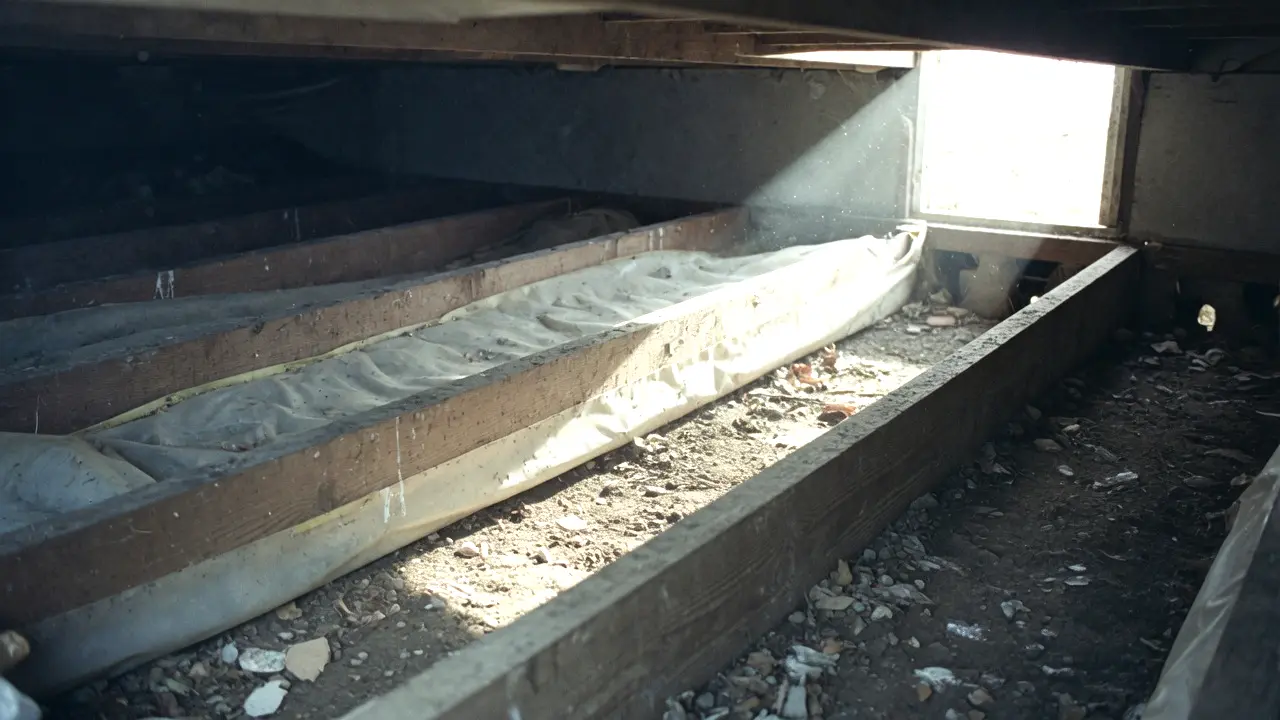
How do I tell whether I have a crawl space or a slab?
Walk outside and look at the bottom few feet of your exterior wall. Small rectangular vents or a low hatch door means a crawl space. A clean line where the siding meets concrete, with no vents anywhere, usually means a slab.
Five checks that take about ten minutes:
- Steps at the door. Crawl space houses usually sit two or three steps above the yard. Slab houses sit nearly level with the driveway.
- Vents and a hatch. Foundation vents around the perimeter are the giveaway. The hatch is often on a side or back wall, sometimes behind a shrub.
- Where the air comes out. Floor registers mean ducts run under the house, so crawl space. Ceiling or high wall registers mean ducts in the attic, so slab.
- How the floor feels. Wood over a crawl space has a slight flex and sounds hollow underfoot. A slab feels dead solid, and cold in January.
- Where the plumbing goes. Look under a sink. A drain dropping through the floor points to a crawl space. One leaving through the wall often points to a slab.
Plenty of Hampton Roads houses are both. A 1960s crawl space ranch with a 1990s slab addition off the back is a common pattern here, and the two halves behave differently.
Why doesn't my Hampton Roads house have a basement?
Water, mostly. The water table along the Virginia coast sits only a few feet below the surface in much of the region. Dig the eight feet a basement needs and in a lot of neighborhoods you are below the water line, so builders went up on a crawl space or flat on a slab instead.
The regional numbers say the same thing. That 85.7% slab share for new South Atlantic homes is not a rounding error, and the same analysis puts full or partial basements at roughly one in six new homes nationally. Nearly all of those are north and west of here.
So if a contractor's website is selling basement waterproofing to a Virginia Beach homeowner, that is a fair sign the page was not written for this market.
What does a crawl space mean when a pipe leaks?
It means the water drips into open air under your floor instead of into concrete. That makes the leak much cheaper to find and reach. It also means it can run for months before anyone notices, and wet wood is what rots joists and subfloor.
Worth checking: a musty smell that gets stronger near one room, a soft spot in the floor by a toilet or dishwasher, a water bill that jumped for no reason, or one room that always feels colder than the rest.
The leak itself is usually straightforward plumbing repair. What sat under the bathroom for a season is a second job, and it is the one people do not budget for.
What does a slab mean when a pipe leaks?
Under a slab, the supply lines run inside or beneath the concrete, so the leak hides until it announces itself. The classic signs are a warm patch on the floor, running water you can hear with every fixture off, a spike in the water bill, and carpet that is damp along one edge.
Then you have a real decision. A slab leak can be fixed by breaking out concrete at the leak, or by abandoning that line and rerouting a new one overhead through the attic and down the walls. Rerouting costs more in drywall and paint. Breaking the slab costs more in flooring and disruption. Which is cheaper depends on where the leak sits and what your floors are made of.
The diagnosis has to come first. Anyone quoting the repair before locating the leak is guessing.
Why does my crawl space smell musty every summer?
Humidity. Hampton Roads summer air is warm and wet, and foundation vents let it straight in. It meets cooler surfaces under your floor, condenses on joists, ducts and insulation, and stays there. That is the smell.
It does not stay downstairs, either. Air moves upward through a house, so some of what you breathe in the living room started under the floor. Cupping hardwood, sticky indoor humidity, insulation hanging down in sheets and a musty hall closet often trace back to the same place.
Before you spend anything under the house, walk the outside after a hard rain. Clogged gutters, a downspout dumping at the corner, and soil sloping toward the foundation cause more crawl space water than anything else, and they are the cheapest fixes you will ever make. If the ground under there is still damp once that is sorted, a vapour barrier, sealed vents and a dedicated dehumidifier are the next conversation. That is where Foundation & Crawl Space Repair starts.
Why do my floors feel soft, bouncy or out of level?
Over a crawl space, soft floors are nearly always the wood underneath: joists, girders, sill plates and the piers holding them up. Long term damp plus a small plumbing leak is the usual recipe, and it happens quietly. On a slab, floors that slope and tile that keeps cracking along the same line usually mean the concrete has moved.
Two different problems, two different fixes. That is why "my floor feels wrong" is a diagnosis question, not a quote question. Sistering a rotted joist is a day of work. A settled slab is not.
Some of this needs a licensed structural engineer, and we would rather say so than sell around it. Bowing foundation walls, pier design and anything that changes a load bearing element should carry an engineer's stamp before a contractor starts.
Does my foundation type change my heating and cooling bills?
Yes, mainly through where the ducts live. Crawl space houses run ductwork under the floor in unconditioned, humid air. Slab houses run it through the attic, which in a Tidewater July is the hottest place on the property.
Leaky ducts in a wet crawl space pull damp air into the system and blow cooled air under the house. You pay for both. If the air conditioning runs constantly and the house still feels clammy, the equipment is often not the thing that is broken.
Slabs also hold temperature. A slab floor stays cold well into spring, which is why those rooms can feel colder than the thermostat claims.
Do I need basement waterproofing in Virginia Beach?
Almost certainly not, because you almost certainly do not have a basement. This is the one on the list that is honestly not us. We do not sell basement waterproofing in Virginia, because the service does not match the housing stock here.
What Hampton Roads homeowners actually need is the crawl space version of the same idea: drainage, a ground vapour barrier, sealing and humidity control, plus the gutter and grading work outside. In South Jersey and Delaware County it is a different story, because basements there are standard.
If someone quotes you a five figure interior drainage system for a Virginia Beach house, ask them to show you the basement first.
When should you actually call someone?
Right away: water you can hear or see running under the house, a warm wet patch on a slab floor, a sewage smell in the crawl space, or a floor that gives when you step on it. Those are active damage, and every one of them gets more expensive while you think about it.
Within a week or two: standing water under the house after every rain, a musty smell that is new, a water bill that jumped with no change in use, or a door that has suddenly started sticking.
Do it yourself first: gutters, downspout extensions, and soil graded away from the foundation. That work costs very little and it solves a real share of crawl space moisture. Get it done before you pay anyone for anything under the house.
One safety note. If you open the hatch and see standing water near wiring, or you smell gas, close it and stay out. Call the utility first. If you are not sure which trade you need, call us and we will tell you what we think it is.