
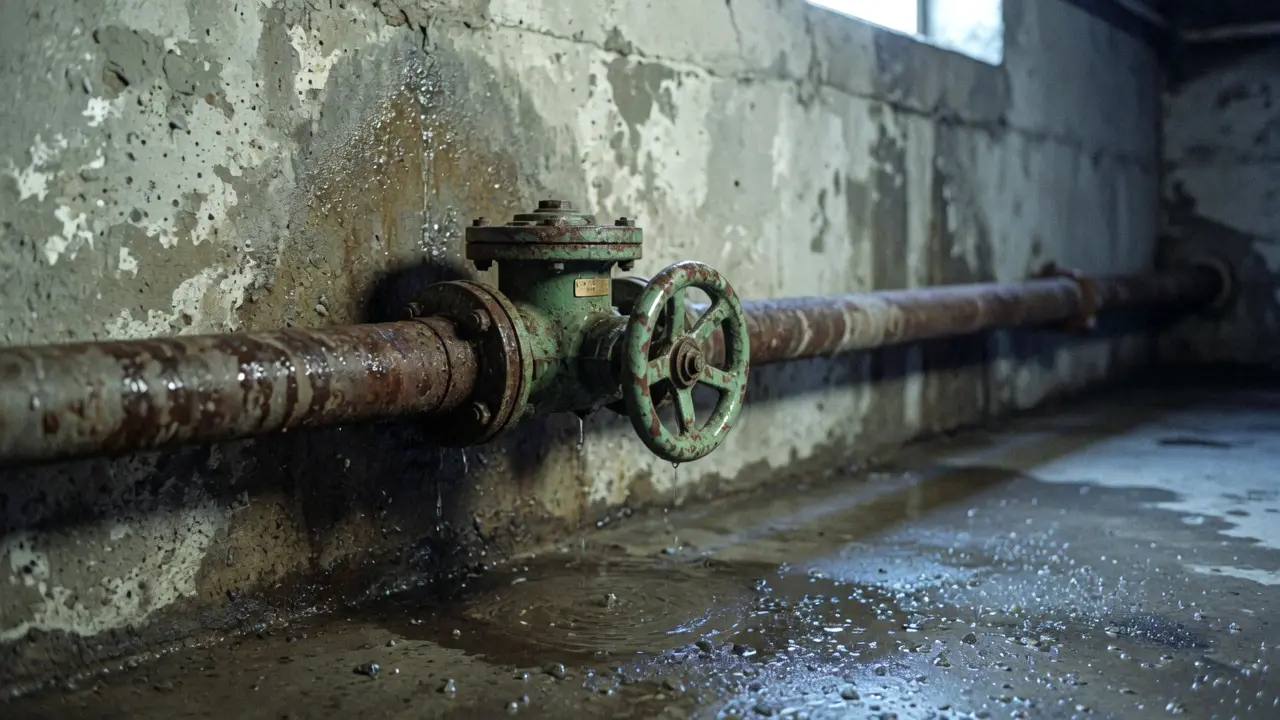
Where is the main water shut-off valve?
In Hampton Roads the main shut-off is usually one of three places. Look first on the garage wall nearest the street, around knee height. If there is no garage, check just inside the crawl space hatch, on the wall closest to the road. The last resort is the meter box at the curb.
Turn it clockwise. A round wheel handle takes several full turns. A lever handle is a quarter turn, and it is closed when the lever sits across the pipe instead of along it.
- Garage wall. Most common in slab homes built after about 1980, often near the water heater.
- Crawl space. Common in older Norfolk, Portsmouth and Hampton houses. Take a flashlight.
- Curb box. A small rectangular lid in the grass near the sidewalk. You need a meter key or a long wrench.
- Interior wall. Sometimes behind the water heater or under the kitchen sink.
If the handle will not move, do not force it. Old gate valves seize and the stem can snap in your hand. Turn it as far as it goes and stop, because even a partial close slows the flood. Then go to the curb.
Some water departments would rather you did not touch the curb stop. In a live flood, stopping the water comes first. Call them afterwards and tell them what you did.
Why should I open a faucet after the water is off?
Because the pipes are still full. Closing the main stops the supply, but every line downstream still holds water and pressure, and it keeps pushing out through the break. Open the lowest faucet in the house and gravity pulls that water toward the drain instead.
The lowest fixture is usually an outside hose bib, a utility sink, or a ground floor tub. Then crack a faucet on the top floor so air gets in behind the water, which empties the lines faster. Flush each toilet once.
Switch the water heater off before you drain the system. Flip the breaker on an electric tank, or turn the gas dial to off. A tank that fires with no water in it can wreck the element.
Should I turn off the power?
Only if the panel is dry and you can reach it standing on a dry floor. Cut the power when water is running near outlets, down a wall, into a ceiling light, or anywhere close to the panel. If any of that is not true, leave it alone and call the utility.
Do it in order. Switch off the individual breakers for the wet rooms, then the main. Use one hand and keep the other off the metal box.
Walk away and call your electric utility from outside if the panel is damp, if you would have to stand in water to reach it, or if you hear buzzing or see a spark. They can cut power at the meter, and it costs you nothing to ask.
What should I photograph before I clean up?
All of it, before you move a single towel. Adjusters pay on evidence, and the evidence starts disappearing the moment you begin drying things out. Five minutes of photos now saves an hour of explaining later.
- A wide shot of every affected room, taken from the doorway.
- The water line on the wall, the baseboard and the furniture legs.
- The burst pipe itself, close up, before anybody cuts it out.
- The ceiling below the leak, including stains that are still spreading.
- Model and serial plates on any appliance that got wet.
Then walk the house on video and say out loud what you are looking at. Keep the cut piece of pipe, because it shows how the failure started. Homeowners policies generally ask you to limit further damage, so shutting the water off and drying things out helps your claim rather than hurting it.
What do I do in the ten minutes after that?
Get water away from anything that soaks it up. Roll back rugs, move furniture off wet carpet, and slide foil or wood blocks under the legs so the finish does not bleed into the pad.
If a ceiling under the leak is bulging, it is holding gallons and it will let go on its own. Stand to the side, never underneath, and poke one small hole at the lowest point of the sag with a bucket below it. One controlled hole beats the whole ceiling landing at once.
Turn the heating and cooling system off if water reached floor registers or the air handler. Running it pushes damp air through every room.
Why did the pipe burst in the first place?
Around here the usual answer is a short hard freeze hitting plumbing that was never protected. Winters on the coast are mild enough that crawl space runs, garage walls and hose bibs stay uninsulated for years. Then one night drops into the low twenties and the exposed stretch splits.
The other causes matter, because they change who should be looking at it.
- Freeze damage. Usually a crawl space run, a pipe in an exterior wall, a garage line, or a hose bib with the garden hose still screwed on.
- Old pipe. Galvanized steel in pre-1970s Norfolk and Portsmouth homes rusts closed from the inside and then splits. Polybutylene from the 1980s and 90s fails at its fittings.
- High water pressure. Most plumbing codes call for a pressure reducing valve above 80 psi. A gauge that screws onto a hose bib reads your pressure in seconds.
- A supply line rather than a pipe. Washing machine hoses, toilet supplies and icemaker lines fail far more often than pipe does.
A freeze burst in a crawl space is rarely only a plumbing problem. If outside air moves freely under the house, the same pipe freezes again next winter. That is a crawl space and foundation question sitting under a plumbing symptom.
Who fixes the damage the water left behind?
The pipe repair is the small part. What takes the time is the drywall, the ceiling, the insulation, the flooring and the paint. Wet insulation does not dry back to useful, it gets replaced. Drywall that sat wet gets cut back to the nearest dry stud.
That is where one burst pipe turns into four phone calls. One trade fixes the pipe. Another opens and patches the ceiling. Another pulls the flooring. Another paints the room back.
Sharpline covers plumbing, drywall & painting and flooring, so the ceiling that gets opened for the pipe is the same ceiling that gets closed and painted. Ask us how the sequence would run on your damage when you call.
When should I call someone, and when can I handle it myself?
Call the utility before you call a contractor in three situations. If you smell gas, leave the house and call the gas utility or 911. If water is at the panel, or an outlet is buzzing or sparking, leave and call your electric utility. If you cannot stop the water, call your water department and ask them to close the curb stop.
Call a plumber tonight if the water is off and staying off but the house has none, or if the break is inside a wall, under a slab, or somewhere you cannot see. Same answer if your house has polybutylene, because one failed fitting usually means others are close behind.
You may not need us at all, and we would rather say so. If the break is one reachable copper or PEX line, and you own a pipe cutter, a push fit coupling is a repair a homeowner can make.
One more honest split. If water has been standing over a day, or it is deeper than an inch across a room, the drying is a water restoration job with commercial air movers and moisture meters. That is a different trade from plumbing repair. Call us and we will tell you which one you need.