
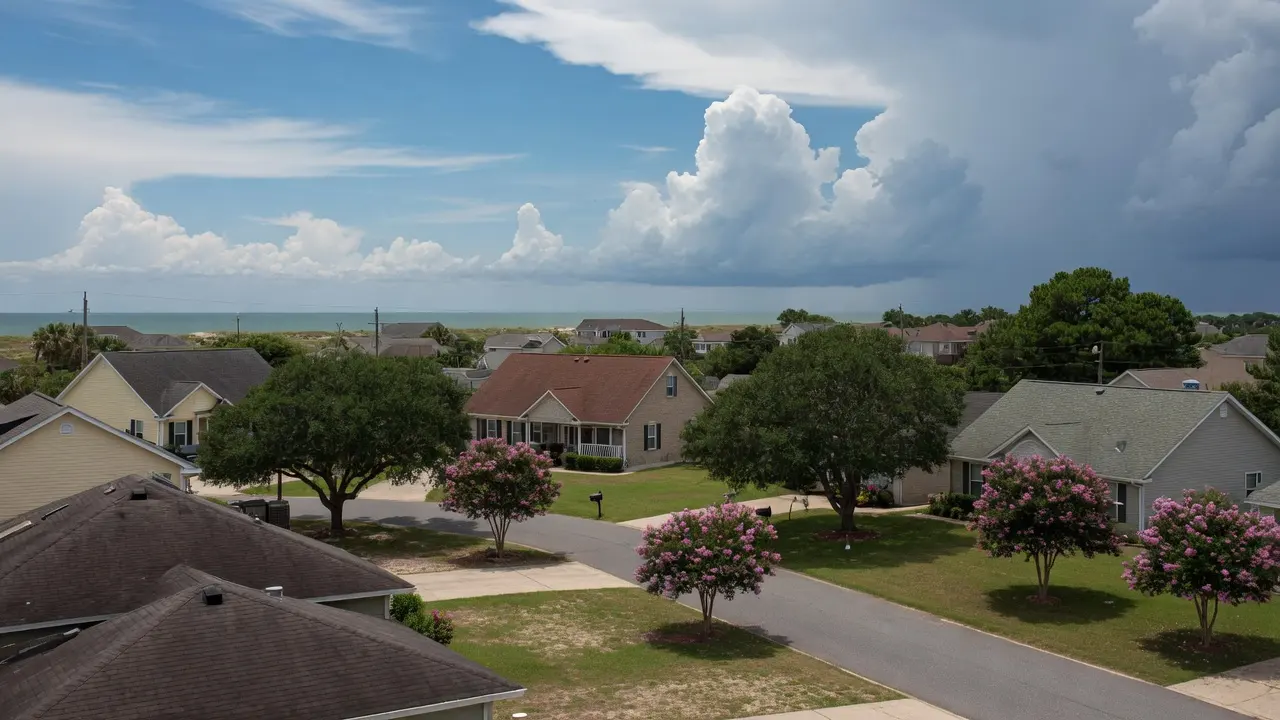
Virginia Beach roofer for repairs and re-roofs
Roofing in Virginia Beach comes with its own permit rule, the state's one-layer limit on nail-overs, a large stock of attached townhouses and a record of nor'easter and tornado damage.
Roofing across Hampton Roads, Virginia
Roofing in Virginia Beach
Roof replacement in Virginia Beach is permit work, unlike Norfolk
Virginia Beach is part of the Hampton Roads roofing work Sharpline Home Services, a division of Sharpline Inc., takes on, along with Chesapeake and Newport News, for both leak repairs and full roof replacements. Before any price, the first step is counting the layers already on the roof and tracing where the water gets in, because under Virginia's re-roof rules, which the Virginia Beach permit form repeats, that layer count decides whether a nail-over is allowed at all.
Virginia Beach lists roofing replacements among the residential jobs that need a building permit. Its neighbors draw the line differently. Norfolk says one- and two-family re-roofs need no building permit at all. Chesapeake's homeowner guide exempts a shingle-for-shingle replacement with up to eight sheets of decking, and asks for a permit and plans only past that. So the same roof, on the same kind of house, carries different paperwork depending on which side of a city line it sits. In Virginia Beach the permit comes from the Permits and Inspections Division at Municipal Center Building 3, 2403 Courthouse Drive. Roofing gets one inspection, the final, once the new roof is on.
Fire-retardant plywood along townhouse party walls
The 2021 Virginia Residential Code lets a townhouse roof run over a separation wall without a parapet when the sheathing is noncombustible or fire-retardant-treated wood for 4 feet on each side of that wall. The Virginia Beach roofing permit application reflects this with a separate scope for fire-retardant-treated plywood in attached dwelling units. The USDA Forest Products Laboratory reports that from 1985 to 1995 about 750,000 multifamily housing units had roofing problems because fire-retardant plywood sheathing broke down from heat exposure. The laboratory gives no Virginia Beach figure, but that period overlaps the 1980s, the city's busiest building decade, so the strip of sheathing along each party wall deserves a close look once the old covering is off.
Rusted metal cannot go back on under the state re-roof rules
Re-roofing an existing house in Virginia falls under the 2021 Virginia Existing Building Code, in effect since January 18, 2024. Section 602.3.2.1.3 says vent flashing, metal edgings, drain outlets, collars and counter-flashing may not be reinstalled where they are rusted, damaged or deteriorated. Under that rule, corroded metal is a line item on the scope, not something reused by default. The same code gives one allowance in the other direction: an ice barrier membrane already adhered to the deck may stay in place and be covered with a new layer of ice barrier instead of being scraped off. When comparing roofing companies in Virginia Beach, check that each written scope prices new metal wherever the old is corroded.
A housing stock built mostly between 1970 and 1999
The Census Bureau's 2024 American Community Survey counts 192,239 housing units in Virginia Beach. The 1980s alone produced 51,708 of them, the largest single decade, and 58 percent date from 1970 to 1999. The same survey puts 100,297 homes in the single-family detached column and 36,001 in single-family attached. Those attached units are where the fire-retardant sheathing rule described above comes into play.
Nor'easters and tornadoes strip roofs here too
The November 2009 nor'easter known as Nor'Ida peaked at a 75 mph gust at NAS Oceana, per the regional hazard mitigation plan. On April 30, 2023, an EF-3 tornado with an estimated 145 mph peak ran 4.5 miles from the eastern branch of the Lynnhaven River to Fort Story, and some houses in the Chelsea neighborhood and on Haversham Close had the roof torn off. In March 2017 a weaker tornado crossed Kempsville, Stumpy Lake, Salem and Holland Road, pulling sections of roofing off houses. The 2023 path was at most 350 yards wide, so one street's damage says little about the roof two streets over.
Virginia Beach roofing questions
Straight answers.
Can a new roof go over my old shingles in Virginia Beach?
Only if the roof has one layer on it now. The city's July 2025 roofing permit application offers a nail-over only where one layer of roofing exists, and Section 602.3.2.1.2 of the 2021 Virginia Existing Building Code bans a roof-over once there are two or more layers. The same section also rules it out when the existing roof is water-soaked or deteriorated, or when it is slate, clay, cement or asbestos-cement tile. If an earlier owner already nailed a second layer over the original, the next job is a full tear-off.
Do I need a permit for a small roof repair in Virginia Beach?
Usually not. The statewide building code says replacing 100 square feet or less of roof covering needs no permit in any wind zone, and replacing 256 square feet or less of roof decking on a house or townhouse needs none either, unless that decking had to be fire-retardant-treated when the house was built, as it often is along a townhouse party wall. Inside one of the city's historic and cultural districts, such as those around the Adam Thoroughgood House or Old Donation Church, roof repairs and maintenance need a Certificate of Appropriateness from the Historical Review Board, with applications due by the 10th of each month.
Does an older Virginia Beach home need an asbestos inspection before a re-roof?
Not if it is a single-family house or a residential building with four or fewer units, unless the work is for commercial or public development. Virginia Code section 36-99.7 requires an asbestos inspection certification before a renovation permit is issued for a building first permitted before January 1, 1985. For larger buildings, a roofing-only job can instead state that the materials are assumed to contain asbestos and that any removal will be done by a licensed asbestos contractor. That 1985 cutoff lands in the middle of the city's biggest building decade, and the city's roofing permit form carries a matching asbestos exemption line.
When is the best time of year to replace a roof in Virginia Beach?
Outside July, August and September, which are the three wettest months at Norfolk International Airport, the long-record National Weather Service climate station for the area. Their 1991 to 2020 rainfall normals are 6.08, 5.88 and 5.40 inches, and all three fall inside hurricane season, so a roof opened for a tear-off in those months faces the most rain. Winter is less of an obstacle. The normal January low is 33.6 degrees and normal snowfall is 6.2 inches a year. Asphalt shingles do seal down best in warm sun, so a cold-weather install can take longer to bond.
Can a roofer in Virginia pay or waive my insurance deductible?
From January 1, 2027, no. Virginia's Residential Property Owners Protection Act bars a contractor from paying, waiving or rebating any part of the deductible on an owner-occupied home's policy, or offering anything of value in exchange for a roof inspection or a claim. Home roofing contracts must carry a bold 14-point notice telling you to check coverage with your insurer before signing, and one missing the required notice on prohibited practices can be voided within 10 days. If you sign within 180 days of a Governor's state of emergency for your area, you can cancel within 10 days or by the official start date, whichever is earlier.
Book a roof inspection in Virginia Beach.
If you know how many layers are on the roof, or that the house is a townhouse, say so; the first visit starts there.