
Roofing contractors in Pittsburgh and Allegheny County
About one residential roof in five inside the city is not shingle, the material changes from ward to ward, and the city's code leaves roofing off its permit-free list.
Roofing across Pittsburgh and Allegheny County, Pennsylvania
Roofing in Pittsburgh
What Pittsburgh roofs are actually made of
From the city wards out to Mt. Lebanon, Bethel Park, Upper St. Clair, Monroeville, Penn Hills, McCandless and Moon Township, Sharpline Home Services, a division of Sharpline Inc., repairs and replaces roofs across Pittsburgh and Allegheny County. Inside the city, roof replacements are filed as building permits with PLI.
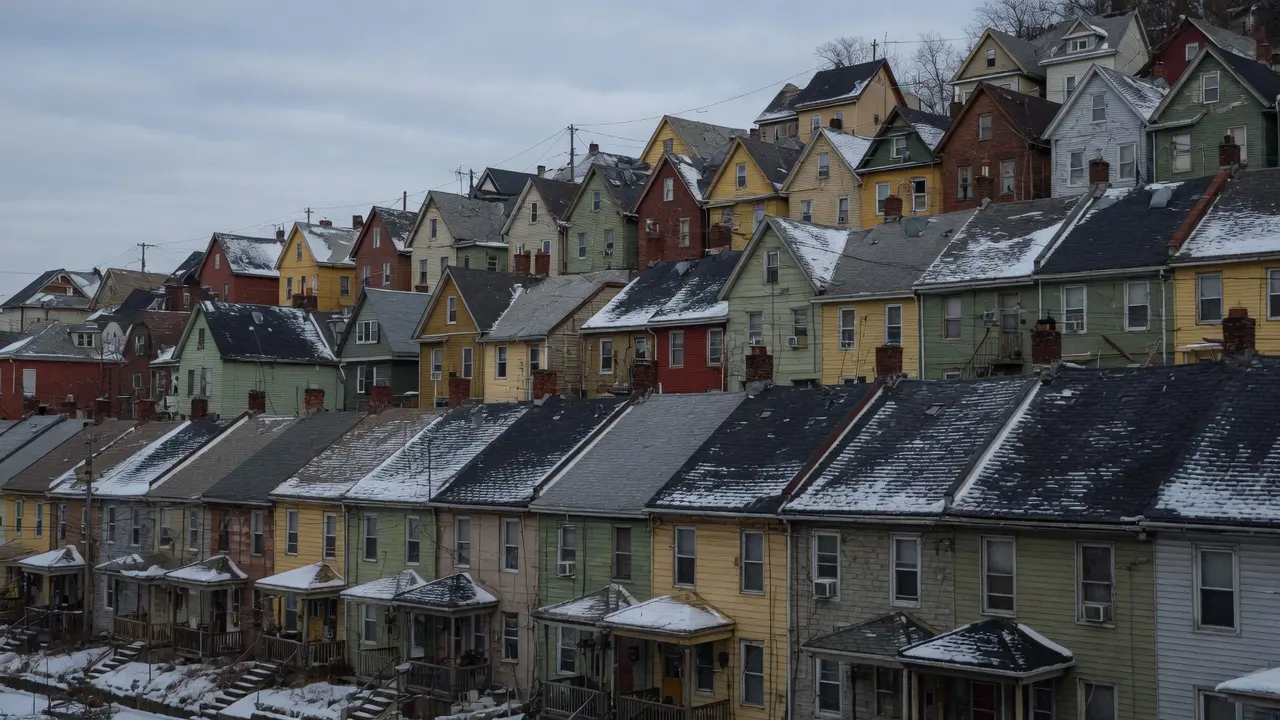
Allegheny County's property assessment records list a roof material for 96,748 residential parcels inside the City of Pittsburgh. 79.5 percent are shingle, 12.4 percent are roll roofing and 6.9 percent are slate, and tile, metal and rubber make up the last 1.2 percent. Across the whole county, shingle rises to 90.8 percent, slate drops to 4.3 and roll roofing to 4.1. So a house inside city limits is about three times as likely as the county average to sit under roll roofing, and noticeably more likely to sit under slate. That changes the first question a roofing company in Pittsburgh has to answer. A pitched shingle roof, a low-slope roll roof and a slate roof let water in at different places, get repaired in different ways, and fall under different code rules when they come off.
Slate and roll roofing cluster by neighborhood
The citywide split hides how clustered the materials are. In Ward 14, which takes in Squirrel Hill North and South, Point Breeze, Regent Square and Swisshelm Park, 2,142 of 10,065 residential parcels are slate, about 21 percent. Ward 7, Shadyside, is 12.9 percent slate and 40.2 percent roll roofing. Ward 2 is 80.4 percent roll, and Ward 4, Oakland, is 47.8 percent. Roll roofing is a low-slope material, and it lets water in at its laps, seams and edges long before the surface wears through.
Sixteen historic districts add a review before the permit
The city has 16 locally designated historic districts, among them the Mexican War Streets, Allegheny West, Deutschtown, Manchester, Schenley Farms and Murray Hill Avenue. Inside them, a Certificate of Appropriateness is required before PLI will issue a building permit. Changing the material, slate to asphalt for example, goes to a full Historic Review Commission hearing, while a replacement with the same material, design and texture can be approved by City Planning staff. Review covers anything visible from a street, alley or lane. The Mexican War Streets guidelines favor keeping slate, accept synthetic slate or black or dark-gray fiberglass shingles when it cannot be kept, and ask that visible built-in box gutters stay.
The city's code calls for ice shield at the eaves
Pittsburgh's local amendments to the residential code list ice-shield underlayment as required in their climatic design table. Pennsylvania's Uniform Construction Code has used the 2021 International Residential Code since January 1, 2026, and where ice damming is designated, its section R905.1.2 wants an ice barrier from the eave to at least 24 inches inside the exterior wall line. Roofs of 8:12 or steeper also need it at least 36 inches up the slope from the eave edge. For scale, January at Pittsburgh International Airport averages a high of 36.3F, a low of 21.4F and 13.3 inches of snow.
Wind reports here are mostly about trees
NOAA's Storm Events Database logged 588 thunderstorm-wind reports in Allegheny County from 2016 through 2025, climbing from 20 in 2016 to 104 in 2025, and 495 of them mention trees. The strongest wind documented in that decade came in the August 24-25, 2023 storms, when a National Weather Service survey near Bruceton found straight-line damage consistent with 90 mph. Seven of the county's 12 confirmed tornadoes in the same span came in 2024. Hail was reported 143 times, with 2.0 inches the largest. On a lot with mature trees, a limb is the likelier storm problem, and a limb goes through decking and can crack a rafter, so the attic gets checked along with the shingles.
Pittsburgh roofing questions
Straight answers.
Do I need a permit for a roof replacement in Pittsburgh?
Inside city limits, plan on one. The city's building code chapter leaves roofing off its list of work that needs no permit, and PLI's permit records show plain roof replacements filed as residential building permits. The suburbs set their own rules. Pennsylvania's code excludes residential repairs unless a local ordinance says otherwise, and Mt. Lebanon, for one, requires a permit only for structural roof repairs.
How fast does PLI need a permit application after an emergency roof repair?
Pittsburgh's amended residential code covers emergencies. Where repairs have to be done in an emergency, the permit application goes to the building official within the next working business day. Pennsylvania's code sets 3 business days by default, and the city's amendment replaces that with the shorter deadline. The amendment does not define what counts as an emergency, so call PLI or file through OneStopPGH as soon as the emergency repair starts.
What happens to a slate roof under Pennsylvania's reroof rules?
Pennsylvania's code lets existing slate go back into a repair unless a piece is damaged, cracked or broken, and it does not allow shingles to be laid over slate, so on a slate roof the choice is repair or full removal. In Ward 14, where about one residential parcel in five is slate, that question comes up on nearly every roof.
Can an ice storm damage my roof in Pittsburgh?
Yes, mostly through the weight it puts on whatever hangs over or off the roof. The February 3-4, 2022 winter storm left a measurable glaze of ice at Pittsburgh International Airport. A glaze of ice adds real load to tree limbs, gutters and service wires, and a limb that gives way under it lands on the shingles. Once it melts, look at the gutter fasteners from the ground and check the attic for fresh stains before the next freeze.
Around Pittsburgh
Roofing near you.
Is it shingle, roll roofing or slate?
Tell us that, the address, and whether it is in the city or a suburb or inside a historic district, because those decide the permit path. If the roof is real slate, say so; slate repair is its own trade, and we will tell you honestly whether it is ours.