
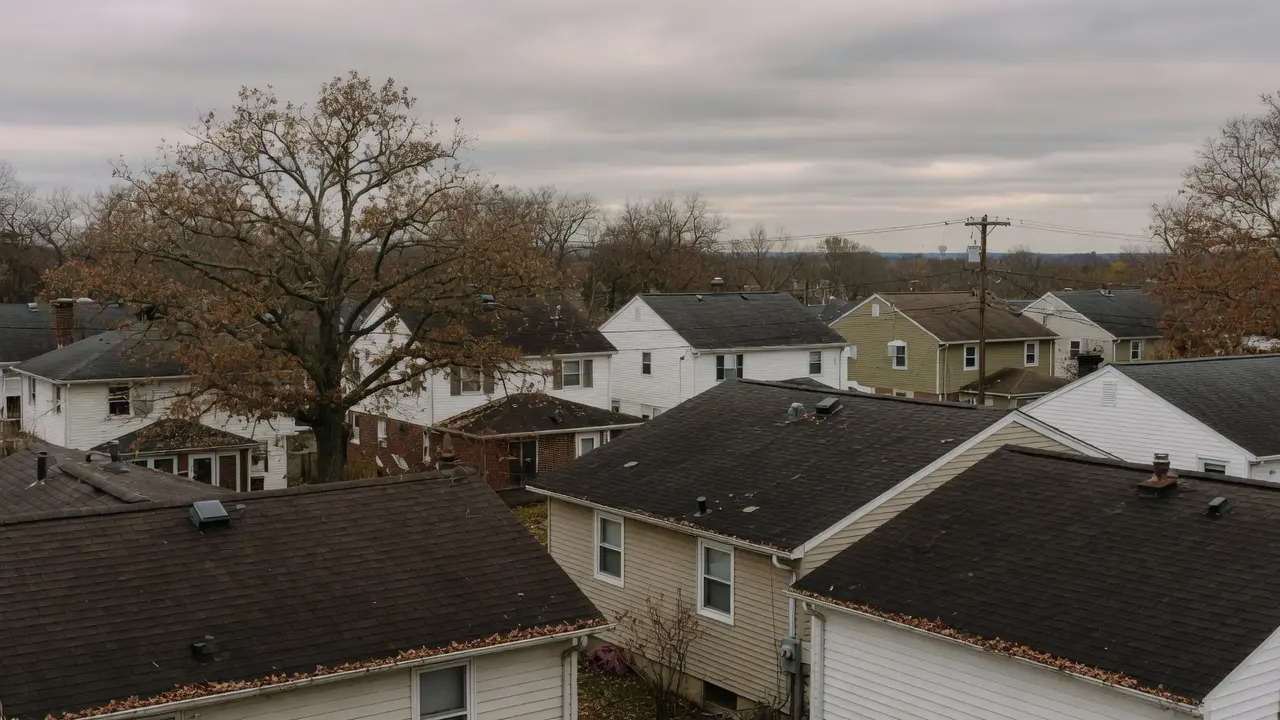
Roofing in South Jersey: repair and replacement
A South Jersey roof has to handle freeze-thaw winters, hot summers and the occasional violent storm, and New Jersey's code checks less of that work than you might expect.
Roofing across South Jersey, New Jersey
Roofing in South Jersey
What nobody inspects on a South Jersey re-roof
Sharpline Home Services does roof repair and replacement in South Jersey. That covers Camden County, from Cherry Hill, Haddonfield and Pennsauken out to Voorhees, plus Moorestown, Mount Laurel, Cinnaminson and Medford in Burlington County and Deptford in Gloucester County. The work runs from a single failed flashing detail to a full tear-off down to the deck.
New Jersey's code asks less of a re-roof here than people expect. It calls for an ice barrier at the eaves only where the average January temperature is 25°F or lower, and the state's Department of Community Affairs says that means Sussex County alone. January normals run 34.3°F at Moorestown and 32.6°F at Pennsauken. On a detached house the job also goes ahead without a construction permit, so nobody from the township sees the eave before the shingles cover it. In these three counties, whether ice-and-water membrane goes along the eaves is a decision between the owner and the roofing contractor. Ask for it in writing, whoever you hire.
Freeze-thaw, not deep cold, is the winter problem
On NOAA's current climate normals, Moorestown averages 101.8 nights a year at or below freezing but only 7.3 days when the high never gets above it. Pennsauken's figures are 103.2 and 13.6. That leaves roughly ninety days a year that freeze overnight and thaw by afternoon. When snow is on the roof, meltwater runs down to the cold eave and refreezes, and each cycle works at sealant, nail holes and flashing joints that were already open. Summer wears on the roof from the other direction. Moorestown averages 44.9 days a year at 90°F or hotter, which is what dries out asphalt shingles and the rubber seals around vents. Annual precipitation there runs just over 49 inches.
The age of the house decides whether an overlay is allowed
Half of Haddonfield's homes were built in 1939 or earlier. In Cherry Hill 72.8 percent predate 1980, and in Mount Laurel 52.6 percent went up between 1980 and 1999. A house from either of the first two groups may be on its second or third covering by now. That matters because New Jersey's Rehabilitation Subcode requires a full tear-off in three cases: when the roof already has two or more layers, when the existing covering is slate, wood shake, clay, cement or asbestos-cement tile, or when the old roof is water-soaked or too deteriorated to serve as a base. A quote that prices an overlay on one of those roofs is pricing work the code does not allow.
One home in four in Mount Laurel shares a wall
Census figures put attached single-family homes at 25.2 percent of the housing in Mount Laurel, 10.9 in Voorhees and 8.1 in Cherry Hill. The ordinary-maintenance exemption names detached one- and two-family dwellings only, and the state's list of minor work does not include roofing, so on a townhouse or twin confirm with the local construction office before a date is set. If a permit applies, an inspection comes with it. That inspection is the one point in the job where someone outside the contract looks at the work.
In Haddonfield and Moorestown, no permit does not mean no review
Both towns have historic districts that review roofs the state code leaves alone. Haddonfield's ordinance counts re-roofing as an alteration. A repair that changes nothing about the roof's design, material or appearance is exempt. In-kind replacement of roofing or gutters is a minor project, and the commission chairperson has 14 days to decide whether it can be approved administratively. The application needs a photo of the existing roof and a description of the flashing, gutters and downspouts. In Moorestown's designated district around Main Street and Chester Avenue, patching a dozen missing shingles counts as maintenance, while in-kind replacement goes to a subcommittee that decides within seven days, before any township permit.
South Jersey roofing questions
Straight answers.
Does South Jersey get wind strong enough to damage a roof?
Yes, and it does not take a hurricane. The June 3, 2020 derecho brought measured gusts of 65 mph at Moorestown and 59 mph at Pennsauken, and the State Climatologist wrote that the wind, not the rain, did the damage, bringing trees and branches down onto buildings. On September 1, 2021, the Harrisonville-Mullica Hill-Deptford tornado in Gloucester County was rated EF-3 with estimated peak winds of 150 mph. In the Willow Oaks subdivision, homes lost roofs and upper-story walls.
What wind speed should a roofer in South Jersey build a new roof for?
There is no single number for the region, because New Jersey's code makes design wind speed site-specific. DCA Bulletin 19-1 points to the ATC or ASCE 7 hazard tool, looked up by street address or by latitude and longitude to five decimal places. The state's amendments to the code's climate table mark the windborne debris region, the special wind region and topographic effects as not applicable here. Ask whoever quotes the job what figure came back for your address and which shingle and nailing pattern is rated to meet it.
Do solar panels need a permit to come off for a new roof in New Jersey?
Not a building permit, on a detached one- or two-family house. The Department of Community Affairs addressed this in its Construction Code Communicator: taking existing rooftop panels off for a re-roof and putting them back needs no building permit. An electrical permit comes in only if the rails are removed and the grounding and bonding is compromised. Ask before the job starts whether the rails will come off, because that answer decides whether a permit and an inspection are part of the schedule.
Where does a roofing permit get filed in Cherry Hill?
With Cherry Hill's Construction Code Official at 820 Mercer Street, Room 205, on the state DCA permit forms. For a roof, that usually means an attached home, which is the case the ordinary-maintenance rule leaves out. For a Cherry Hill townhouse or twin, ask the construction office about the specific address, and settle who files the permit before a start date is set.
Can I tarp a storm-damaged roof in Haddonfield's historic district before getting approval?
Usually, yes. Haddonfield's code does not require Historic Preservation Commission approval before an emergency repair needed to keep the house habitable or its occupants safe, and a temporary cover after storm damage is the kind of work that provision is meant for. Two conditions apply. The owner has to ask the Administrative Zoning Officer for the Commission's review at the same time the emergency work starts, and the officer has to certify that the need is immediate. The work has to be limited to what safety and habitability require, temporary measures should be reversible without damaging the structure, and the request for a Certificate of Appropriateness must be made within five days of the emergency. No further work can happen until that certificate is issued. Moorestown's newer ordinance takes a similar line for historic sites and contributing properties: emergency repairs can go ahead as long as the request for review is made at the same time the work starts. The permanent roof is reviewed afterward in the usual way.
Around South Jersey
Roofing near you.
Tell us the address and what is on the roof now.
Say whether the house is detached or attached and whether it sits in the Haddonfield or Moorestown historic district, because both change what has to happen before the old roof comes off.